
You walk a Paradise Valley property on a bright morning, and everything looks fine from the curb until you slow down. Dust is sitting on the lower window frames. Hard water marks catch the light on the glass. A roof scupper has desert debris packed into the corner. One downspout dumps too close to the foundation. The gravel bed near the drive has been disturbed by recent grounds maintenance, and nobody has mentioned whether the crew handled dust control correctly.
That's how Paradise Valley property maintenance usually works in real life. Problems rarely announce themselves with a dramatic failure first. They show up as small misses that chip away at appearance, create inspection concerns, or turn into preventable repair calls during monsoon season.
For owners, facility teams, and property managers, the local standard is high given the significant value of properties. Paradise Valley's median home sale price reaches $4,687,500 according to local market data from Realtor.com. In a market like that, exterior upkeep isn't just cosmetic. It affects how a property is perceived, how smoothly vendors work, and whether routine maintenance stays routine.
Why Paradise Valley Maintenance Matters
A Paradise Valley property can look polished at 8 a.m. and start showing trouble by noon. Dust settles fast on lower glass and dark trim. Irrigation leaves mineral spotting that catches sunlight. A blocked scupper or poorly aimed downspout may sit unnoticed until the first hard monsoon rain sends water where it should never go.
That is why maintenance here works like a health check, not a beauty treatment. The goal is not only to keep the property attractive. The goal is to catch small signs early, while they are still inexpensive to correct and before they create drainage problems, surface staining, or avoidable wear.
In a high-value area, appearance sets the tone. Compliance and site control matter too.
A weekly exterior walk should answer a few practical questions. Is dust building up in places guests notice first, such as entry glass, frames, gates, and walkways? Did the last grounds visit leave disturbed gravel, loose debris, or bare soil that can create dust-control concerns? Are roof drains, scuppers, and discharge points clear before storm season puts them to work?
That last point gets skipped in many maintenance guides. In Paradise Valley, exterior upkeep overlaps with local expectations around clean sites, controlled dust, and stormwater flow. If a crew blows debris into the street, leaves fine soil exposed, or ignores runoff patterns near hardscape and foundations, the issue is no longer just curb appeal. It becomes an operations problem that can affect neighboring property, inspection readiness, and repair costs.
The easiest mistake is treating each task as its own lane. Window washing, wash-downs, trimming, gravel reset, drainage checks, and hardscape cleaning all work together. A property works the same way a roof system works. One weak connection may look minor on a clear day, but it changes how the whole system performs when heat, wind, or monsoon rain show up.
What people often miss
Owners and managers usually understand the visual side first. Clean glass, tidy edges, and stain-free walkways make a property feel cared for. The part that causes confusion is the order of operations.
For example, a team may schedule pressure washing and glass cleaning but miss the drainage inspection that should happen first. Or a landscaping crew may refresh gravel beds without addressing how dust will be controlled afterward. The property looks better for the moment, but the underlying risk stays in place.
A better approach is to read the site in layers:
- Presentation layer: glass, entry surfaces, gates, walls, and driveway edges that shape first impression
- Control layer: dust, debris, irrigation overspray, and worksite cleanup that keep the property orderly and help avoid complaints
- Protection layer: scuppers, drains, grade transitions, and discharge points that matter most before and during monsoon season
That sequence keeps teams from polishing the surface while missing the system underneath.
Many local crews use a simple curb-appeal checklist before events, listings, or seasonal cleanups. A good one should cover glass, frames, entry paths, visible dust zones, and drainage trouble spots, not just what looks dirty from the street. If you want a practical visual reference, this guide on how to improve curb appeal pairs well with a site walk.
Building Your Maintenance Schedule
A good schedule for Paradise Valley works like a flight checklist. You do the same core checks on a routine, but you also respond to conditions the day you see them. That matters here because a property can look fine from the driveway while dust-control issues or blocked drainage are already setting up the next complaint, citation, or repair bill.
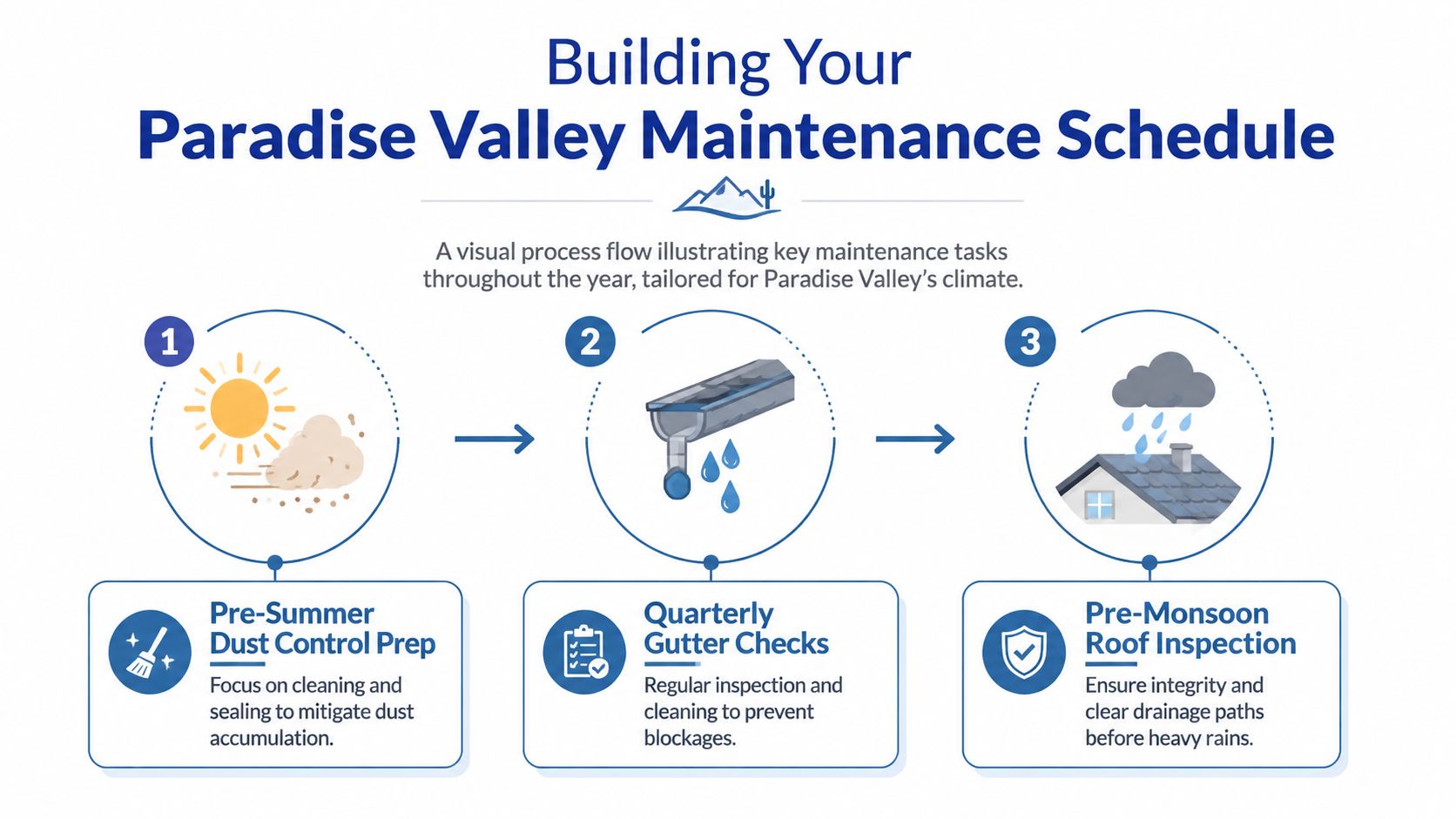
The easiest way to build that checklist is to separate routine work from trigger-based work. Routine tasks keep the site stable. Trigger-based tasks catch the problems that show up after wind, storms, landscaping changes, and vendor activity.
Start with the fixed routine
Fixed tasks are your baseline. Without them, the property slowly slips out of spec even if no single issue feels urgent.
Use a simple recurring schedule like this:
Quarterly filter and system check
Paradise Valley dust loads equipment fast. Set a standing quarterly review for HVAC filters, intake areas, and visible buildup around exterior units before summer demand rises.Quarterly drainage review
Inspect roof edges, scuppers, drains, splash areas, and ground discharge points. On many luxury properties, drainage is partly hidden by design, which makes it easier to miss until monsoon runoff exposes the weak spot.Regular exterior glass and surface cleaning
Dust film, sprinkler spotting, and hard-water residue make a property look tired well before anything is technically broken. Keep glass, entry surfaces, and visible hardscape on a set service interval.Gate and access hardware review
Check hinges, latches, call boxes, and resident access devices on a routine cadence. Multifamily and managed-entry sites should also plan ahead for admin tasks such as replace key fobs for gated communities so access control does not become a last-minute scramble.
Add weather-based trigger points
A calendar alone is not enough in this market. Monsoon prep and dust control need trigger rules your crew can follow without debating every ticket.
Use these field rules:
- Before monsoon season: inspect drains, scuppers, grade transitions, and discharge paths early enough to correct problems before the first heavy storm.
- After any strong storm: walk the property and look for ponding, gravel washout, debris at inlets, erosion at down-slope edges, and mud tracking across paved surfaces.
- If water remains in place after a storm: schedule a closer drainage evaluation. Standing water is a sign that flow is being blocked, slowed, or sent to the wrong place.
- If soil, gravel, or other outdoor elements were disturbed: confirm the crew stabilized the area and cleaned the hard surfaces. In Paradise Valley, dust control is not just housekeeping. It can affect complaints, street cleanliness, and whether the site appears professionally managed.
That last point gets overlooked. A refreshed gravel bed can create a fine dust problem the next windy afternoon if the crew leaves loose material on pavement or fails to secure bare soil. The property may look improved at noon and look neglected by evening.
Coordinate trades in the right order
Scheduling is less about packing in vendors and more about sequencing them. One crew can undo another crew's work in a day.
Use this order:
| Task order | Why it works |
|---|---|
| Landscaping and dust-producing work first | Keeps trimmings, soil, and loose gravel from resoiling finished surfaces |
| Drainage checks and corrective cleanup second | Gives crews a clean view of runoff paths, blocked inlets, and washout points |
| House washing and flatwork cleaning third | Removes residue from walls, walks, and entries before detail work |
| Window cleaning near the end | Protects the finished look and avoids repeat glass cleaning |
| Final site walk after storms or vendor work | Catches drainage trouble, dust migration, and appearance issues before they linger |
If your team wants a practical template, this annual home maintenance checklist for Arizona properties is a useful starting point. Build your own version around local priorities, especially monsoon drainage review and post-work dust control, because those two items often decide whether a property stays polished and compliant between service visits.
Exploring Property Maintenance Services
Property maintenance sounds broad until you break it into service groups. Once you do, the work becomes easier to schedule and easier to evaluate. In Paradise Valley, the most useful categories are glass, washing, drainage, energy-related exterior care, and seasonal presentation work.
Glass cleaning and visibility work
Residential, commercial, and high-rise window washing all solve the same problem at different scales. They remove dust film, hard water spotting, pollen residue, and storm residue that dulls glass and reduce the sharp, crisp look owners expect from a luxury property.
For a home, the visual payoff is obvious. Clean panes brighten interiors and improve the way landscaping, mountain views, and architectural lines read from inside the house. For a commercial or multifamily property, clean storefronts and lobby glass tell visitors the building is actively managed.
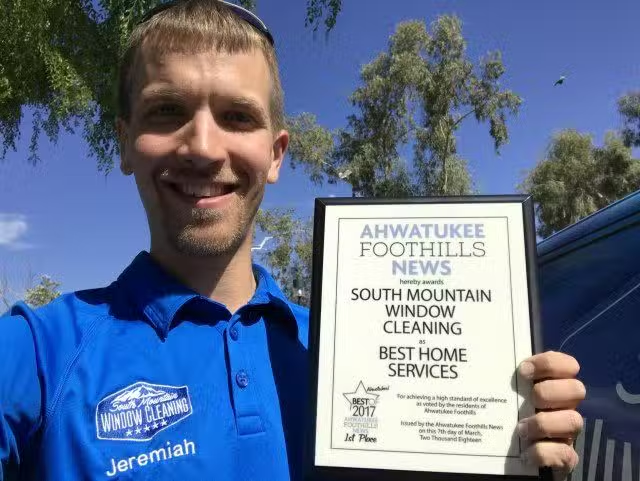
South Mountain Window Cleaning provides residential, commercial, and high rise window washing services in Phoenix, Scottsdale, Paradise Valley, Chandler, Tempe, and Gilbert, Arizona, along with related exterior cleaning services. That matters for managers who'd rather work with one insured vendor that can handle single-family homes, retail storefronts, and taller buildings under the same operating standards.
Washing services that support curb appeal
Window cleaning works best when the surrounding surfaces aren't dragging down the result. That's where power washing, house washing, and flat-surface cleaning come in.
The distinction usually confuses people, so here's the plain version:
- House washing is for broader exterior surface cleaning on siding, stucco, trim, and similar areas where technique matters as much as pressure.
- Power washing is often better suited for hardscape, walkways, dumpster pads, drive-thrus, and other durable exterior surfaces.
- Flat-surface cleaning helps large paved areas look even instead of patchy.
Bundling these services makes operational sense because the property gets reset as one visual system. Clean windows next to stained walkways still look incomplete. Clean walkways below dusty, streaked glass have the same issue.
If you're comparing service bundles and trying to understand quote structure, a practical reference is this page on Phoenix cleaning services cost.
Gutter, roof-edge, and solar-related maintenance
Paradise Valley properties often hide water-management details behind attractive architecture. That doesn't reduce their importance. It increases it. Debris near drains, scuppers, and discharge points can turn a short storm into a staining, overflow, or water-intrusion problem.
Solar panel cleaning fits this same category of quiet performance work. Panels can look acceptable from the ground and still carry a visible layer of dust. The task isn't decorative. It helps maintain proper exposure by removing buildup the desert leaves behind.
A good operations mindset is to group these jobs together when possible:
- Roof-edge checks and gutter cleaning: Best tied to storm prep and storm follow-up
- Solar panel cleaning: Best scheduled with other roof-safe exterior visits
- Window inspection at the same time: Helps crews catch seal, frame, or spotting issues while access equipment is already on site
Seasonal and access-related services
Some exterior work is about function. Some is about presentation windows in the calendar. Holiday lighting is a clear example. So are pre-event cleanups, high-profile guest arrivals, and listing prep.
For gated communities and larger residential portfolios, access planning matters more than many teams expect. If your staff is coordinating vendors, residents, and recurring service visits, it helps to understand systems that replace key fobs for gated communities so maintenance access doesn't turn into a day-of-service bottleneck.
The broader lesson is simple. Don't treat each task as a one-off. Group work by access, by soil type, and by how the property is used.
Understanding Cost Factors
Property maintenance pricing gets confusing when teams compare two quotes that sound similar but don't cover the same conditions. The easiest way to clear that up is to separate routine maintenance budgeting from job-specific pricing variables.
The long-view budget matters first. Experts recommend allocating 4–6% of a property's value to routine maintenance and reserving 10–15% for major system replacements to avoid emergency expenditures according to Property Meld's maintenance budgeting guidance. That doesn't mean every dollar goes to exterior cleaning. It means routine care should already be expected, funded, and planned instead of treated as a surprise.
What changes a maintenance quote
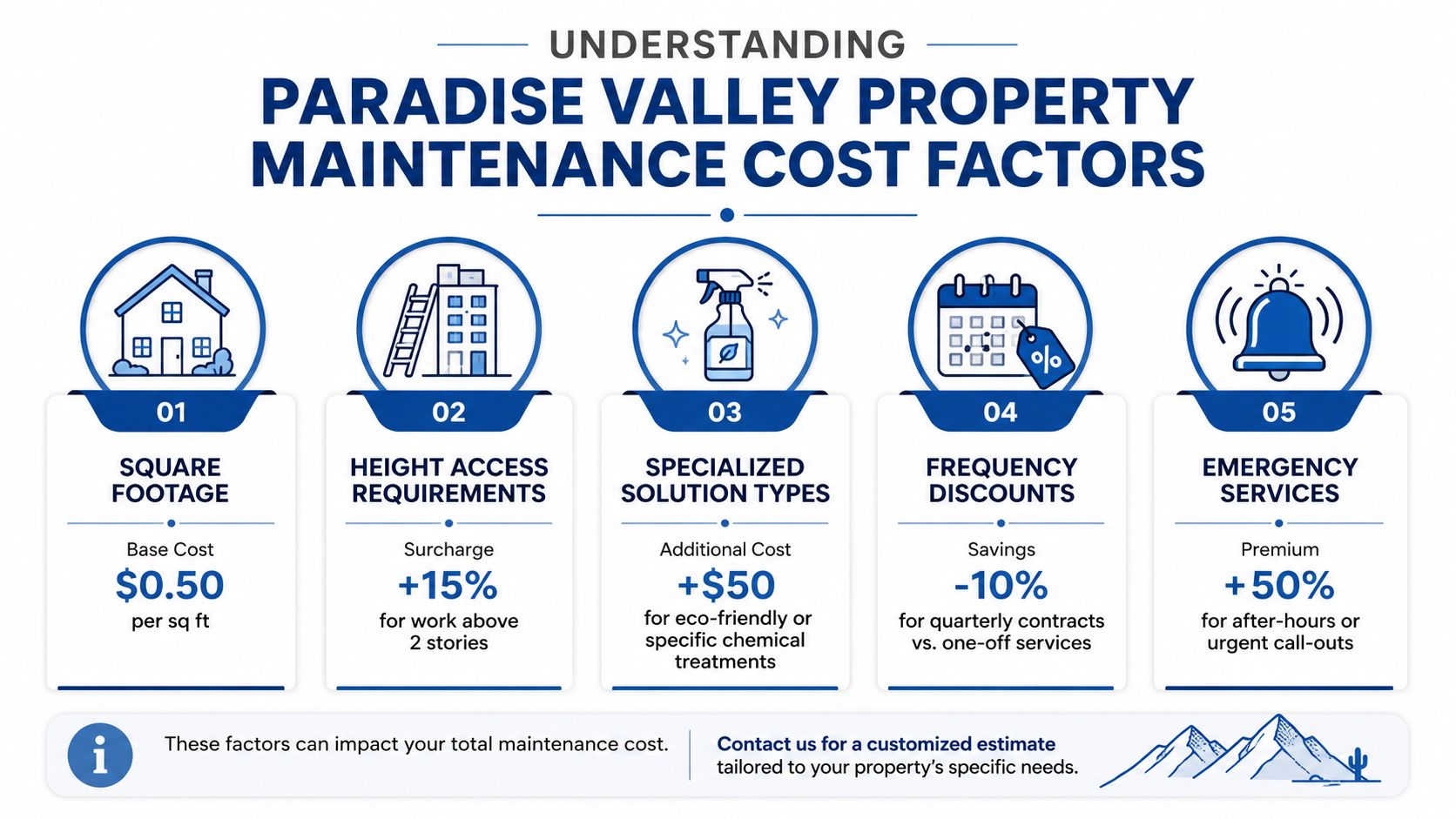
A real estimate usually moves up or down based on five practical variables:
- Property size: More glass, more flatwork, and more perimeter usually means more labor.
- Height and access: Upper-story glass, atriums, roof access points, and interior obstruction all affect time and safety setup.
- Surface condition: Light dust is one thing. Hard water, oxidation, oil residue, or post-storm buildup takes more effort.
- Service frequency: Recurring work often prevents the heavy restoration conditions that make one-time visits slower.
- Urgency: Rush scheduling during monsoon season or before a showing usually costs more than planned recurring work.
Why cheap quotes often become expensive jobs
A low price can hide missing scope. Maybe the bid covers glass but not frames and tracks. Maybe it excludes hard water removal. Maybe the crew hasn't priced difficult access correctly. By the time the work order changes on site, the “cheap” bid isn't cheap anymore.
This is also why managers should separate cleaning from specialty remediation. If the property has attic contamination, insulation dust, or neglected interior air-quality issues tied to deferred upkeep, that's a different budget category. A helpful comparison point is this guide on how much attic cleaning costs, which shows how hidden-condition work differs from standard recurring service.
Good budgeting doesn't chase the lowest number. It matches the scope to the condition of the property and the consequence of delay.
A cleaner way to compare proposals
Use a short side-by-side checklist before approving any quote:
| Checkpoint | What to ask |
|---|---|
| Scope | Does the quote include all targeted surfaces and cleanup details? |
| Access | Has the vendor accounted for ladders, lifts, roof lines, or gated entry? |
| Frequency | Is this one-time corrective work or part of a recurring plan? |
| Add-ons | Are stain removal, restoration, or emergency scheduling priced separately? |
If you need a narrower cost reference for exterior hard surfaces, this overview of the cost of pressure washing helps frame the discussion.
Choosing the Right Maintenance Vendor
A Paradise Valley property can look premium and still be poorly maintained behind the scenes if the vendor process is weak. The wrong contractor creates three kinds of risk. Safety risk, scheduling risk, and compliance risk.
That's why vendor selection should be documented, not handled from memory.
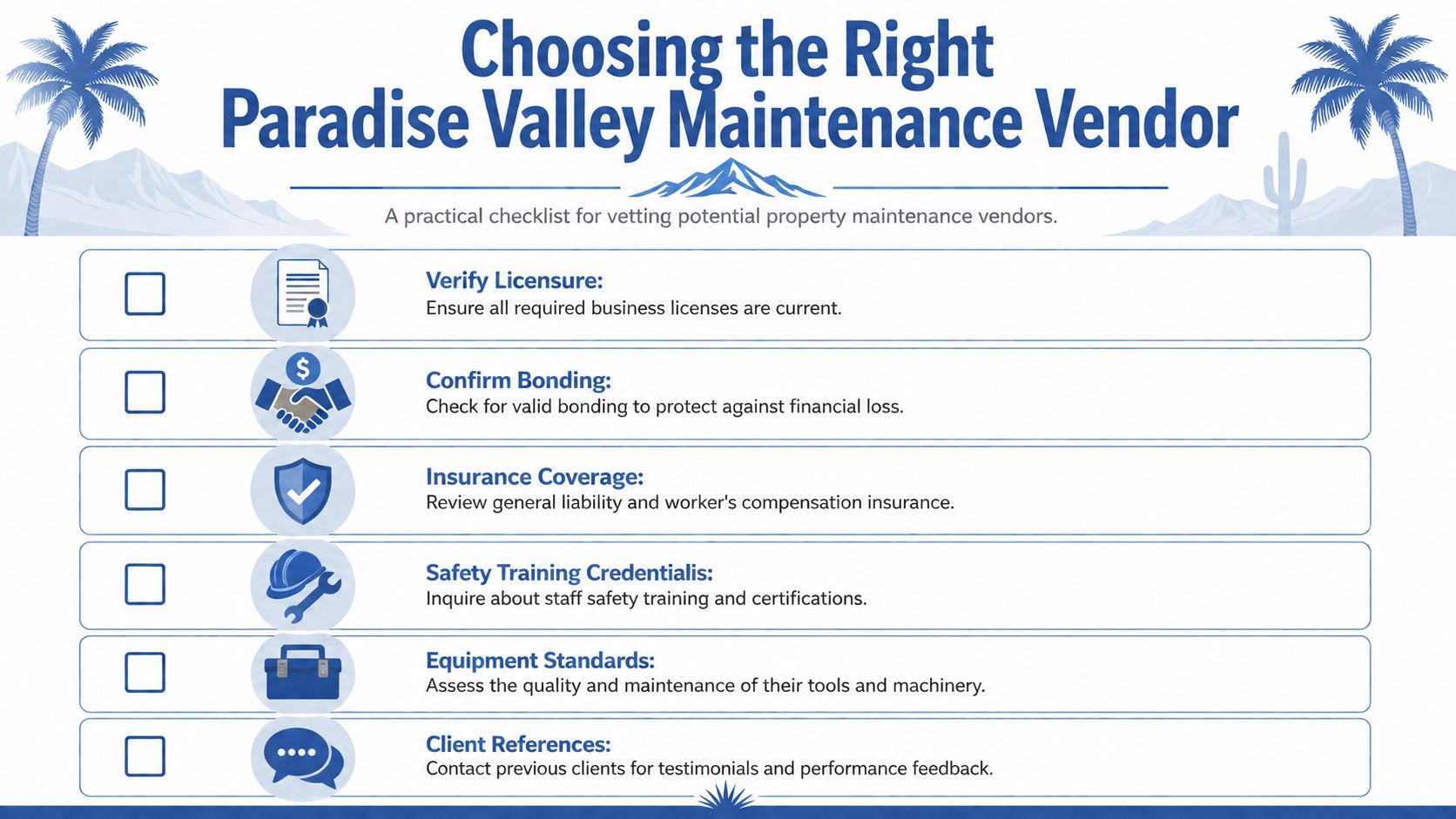
The six checks that matter most
Start with the basics, but don't stop there.
- Licensure: Verify the business is operating properly and that records are current.
- Bonding: Bonding matters because it helps protect against specific financial losses tied to the vendor's work.
- Insurance: Ask for current proof of general liability and workers' compensation coverage.
- Safety training: A polished quote doesn't tell you whether the crew knows ladder safety, roof access discipline, or site protection.
- Equipment standards: Well-maintained tools usually signal a company that also maintains process discipline.
- References: Ask recent clients how the crew handled scheduling, communication, and site cleanup.
How to interview a vendor without wasting time
Keep the conversation practical. Don't ask who is “best.” Ask how they work.
A strong screening conversation includes questions like these:
- Who supervises the work on site
- How do you handle access and scheduling for occupied properties
- What happens if weather interrupts the service
- Can you explain what is included and what is excluded
- How do you document damage, delays, or scope changes
If a contractor can't explain their process clearly before the job, they usually won't become clearer once your property is on the schedule.
The right vendor should reduce management load, not add to it.
Tackling Arizona's Climate Challenges
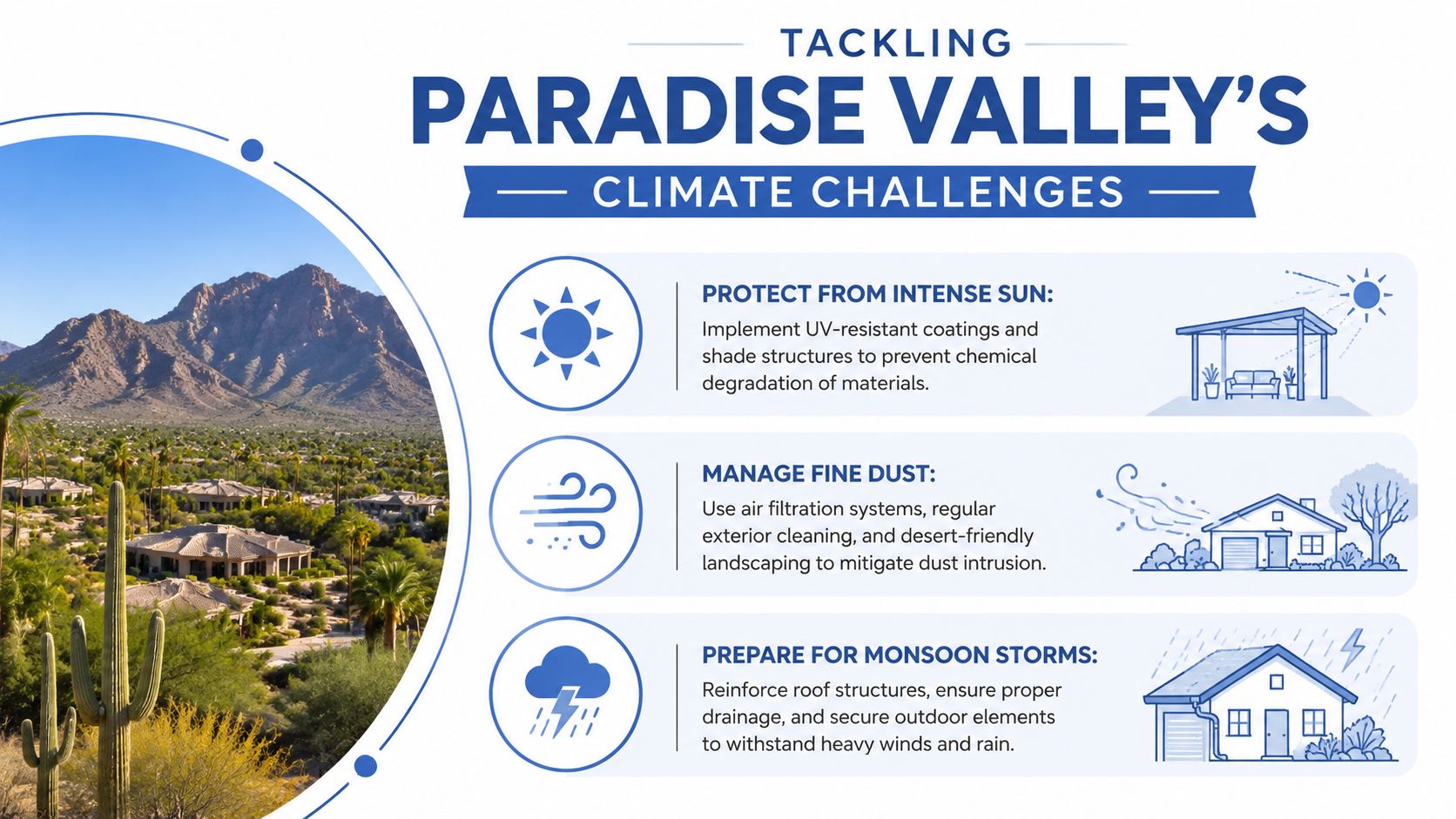
Arizona doesn't damage properties in one dramatic way. It wears them down through repetition. Fine dust settles where owners don't notice it at first. Sun exposure bakes residue onto surfaces. Then monsoon weather tests anything that was ignored.
That's why Paradise Valley maintenance has to treat climate as both an appearance problem and an operations problem.
Dust isn't only a cleaning issue
Most guides talk about dust as something to wash away. That's only half the story. In Paradise Valley, some dust-producing maintenance work crosses into code compliance.
Ordinance 454 mandates written dust-control plans for any grounds work or grading, turning maintenance activities into compliance tasks under Paradise Valley's code according to the Town of Paradise Valley Ordinance 454 document hosted by the EPA. That means owners and managers should ask one extra question before approving grounds improvement or soil-disturbing work: what is the written dust-control method?
Crews may inadvertently create a preventable compliance issue when performing what they believe is ordinary maintenance.
Sun, stormwater, and landscape choices
The sun changes maintenance intervals. Sealants, finishes, and exposed surfaces don't get a mild environment in Paradise Valley. They get prolonged heat and dust loading. Then a storm arrives and tests drainage all at once.
A good field approach looks like this:
- Before heavy weather: Clear drains, inspect roof discharge routes, and secure loose exterior items.
- After dusty periods: Wash glass, frames, and high-visibility surfaces before buildup bakes on.
- During outdoor design: Favor plant choices and layouts that reduce loose, exposed soil where possible.
If your property team is revising the planting plan, it helps to review resources that find commercial drought-resistant trees Arizona so the grounds support both appearance and lower-stress maintenance.
What local teams should watch first
The first signs of climate trouble are often subtle:
| Area | What to look for |
|---|---|
| Glass and frames | Dust film, spotting, residue lines after storms |
| Drainage paths | Debris buildup, sediment, slow runoff |
| Landscape beds | Loose soil, dead plant material, disturbed gravel |
| Outdoor features | Shifted furniture, clogged channels, post-storm mess at entries |
The hidden lesson is that climate prep isn't seasonal theater. It's a habit of catching small exposure problems before weather multiplies them.
Next Steps to Maintain Your Property
A strong Paradise Valley maintenance plan isn't complicated, but it does need discipline. Put the work in the right order. Schedule around weather instead of reacting to it. Bundle compatible services so one crew doesn't undo another. Vet vendors like they're part of your risk plan, because they are.
The teams that stay ahead usually do four things well:
- They keep a year-round schedule
- They combine related exterior services on the same cycle
- They budget routine work before it becomes corrective work
- They check compliance details, not just appearance
For owners and managers who want one exterior cleaning partner, South Mountain Window Cleaning, LLC handles window cleaning, house washing, pressure washing, gutter cleaning, solar panel cleaning, and seasonal lighting for properties across the Valley, including Paradise Valley. The company serves residential, commercial, and high-rise properties and uses pure-water systems and safety-trained technicians, with scheduling available online or by phone.
If your windows, walkways, drainage edges, or exterior surfaces are already showing dust, spotting, or storm residue, waiting usually makes the next service visit more corrective and less routine. It's smarter to price the work while the issues are still manageable and before the next dust event or monsoon round complicates access.
Frequently Asked Questions
How often should solar panels be cleaned in Arizona's dust
They should be inspected on a recurring basis and cleaned when visible dust buildup starts reducing surface clarity. In Arizona, that usually means watching conditions closely after dusty periods and before peak production seasons. If the panels sit near trees, roof runoff paths, or heavy airborne dust, they may need more attention than the rest of the property.
What's the difference between house washing and pressure washing
House washing focuses on exterior walls and delicate finish areas where method matters as much as force. Pressure washing is better suited to tougher surfaces like concrete, walkways, and some hardscape areas. If someone uses the wrong approach, the result can be uneven cleaning or surface damage.
Can I schedule maintenance on short notice during monsoon season
Sometimes, yes, but availability usually tightens when storms are active and many owners need the same help at once. Short-notice work is easier to schedule when you already have a relationship with a recurring vendor. For storm-related needs, tell the company exactly what happened, what areas are affected, and whether access is restricted.
Are there seasonal discounts for bundled services
Some vendors offer better pricing or scheduling efficiency when several compatible services are booked together. The bigger benefit is often operational rather than promotional. One coordinated visit can reduce gate access issues, repeat setup time, and the chance that one service re-soils another.
If you want a fast, free quote for exterior cleaning in Paradise Valley or elsewhere in the Valley, contact South Mountain Window Cleaning, LLC. They serve homes, commercial properties, and high-rise buildings in Phoenix, Scottsdale, Paradise Valley, Chandler, Tempe, and Gilbert, Arizona, with online scheduling and phone support for window washing, power washing, house washing, gutter cleaning, and solar panel cleaning.