
Your utility bill looks fine on paper, but the solar production dashboard tells a different story. Output is drifting, there hasn't been a visible equipment failure, and nobody on site can point to one obvious problem. That's the situation a lot of Arizona property managers face after the install crew leaves and the system moves into normal operations.
On small-to-mid-scale commercial properties, that gap matters. The overlooked middle, roughly the kind of commercial system that's too important to ignore but not large enough to justify a dedicated in-house maintenance team, often loses money imperceptibly. Dust, pollen, bird droppings, roof runoff, and heat exposure don't announce themselves. They just chip away at production and push ROI farther out.
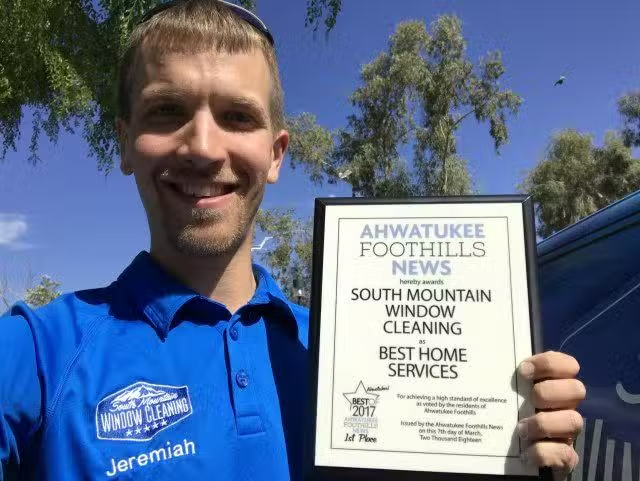
In Phoenix, Scottsdale, Paradise Valley, Chandler, Tempe, and Gilbert, the climate adds pressure. South Mountain Window Cleaning provides residential, commercial, and high rise window washing services in Phoenix, Scottsdale, Paradise Valley, Chandler, Tempe, Gilbert, Arizona. That exterior cleaning background matters because solar performance in the Valley isn't only an electrical issue. It's also a site-condition issue. Dirt on glass is easy to see. Dirt on a solar array is easier to underestimate.
Protecting Your Solar Investment from Day One
Most commercial owners buy solar for one reason. Predictable long-term savings. If the array underperforms, the business case weakens fast, even when the equipment itself is still technically operating.
That's why commercial solar panel maintenance should be treated as asset protection, not janitorial work. In Arizona, panel surfaces collect fine dust long before they look heavily soiled from the ground. By the time a manager notices obvious buildup, production has often been slipping for a while. A basic, practical framework like this solar panel maintenance checklist helps turn maintenance into a repeatable operating process instead of an afterthought.
Output is the real scorecard
A commercial array doesn't need to look dirty to be costing money. It just needs enough surface contamination to cut light transmission, create uneven shading, or trap grime that rain won't remove. In a dry market, waiting until the panels look bad is usually too late.
That's where maintenance earns its keep. It protects generation, supports warranty compliance, and keeps small losses from becoming expensive habits.
Practical rule: If you're reviewing utility savings monthly but not reviewing panel cleanliness on a schedule, you're only managing half the investment.
Arizona changes the math
General advice from lower-dust markets often doesn't hold up in the Valley. Regular rainfall can reduce cleaning needs elsewhere, but Arizona sites deal with dust events, roadside buildup, pollen, and long dry stretches that keep contaminants on the glass. If you want to optimise your solar panel savings, the useful takeaway is simple: maintenance frequency has to match local soiling conditions, not a generic annual calendar.
For commercial property managers, that means tying solar care to business outcomes. The right maintenance plan protects energy production, catches issues before they become repair calls, and gives you a clean record of what was serviced and when. That's how you protect the array from day one, and not just during warranty season.
The Hidden Threats to Solar Panel Performance
The biggest mistake in commercial solar panel maintenance is assuming all dirt causes the same problem. It doesn't. Light surface dust reduces performance one way. Uneven debris causes a different level of risk entirely.
What soiling actually does
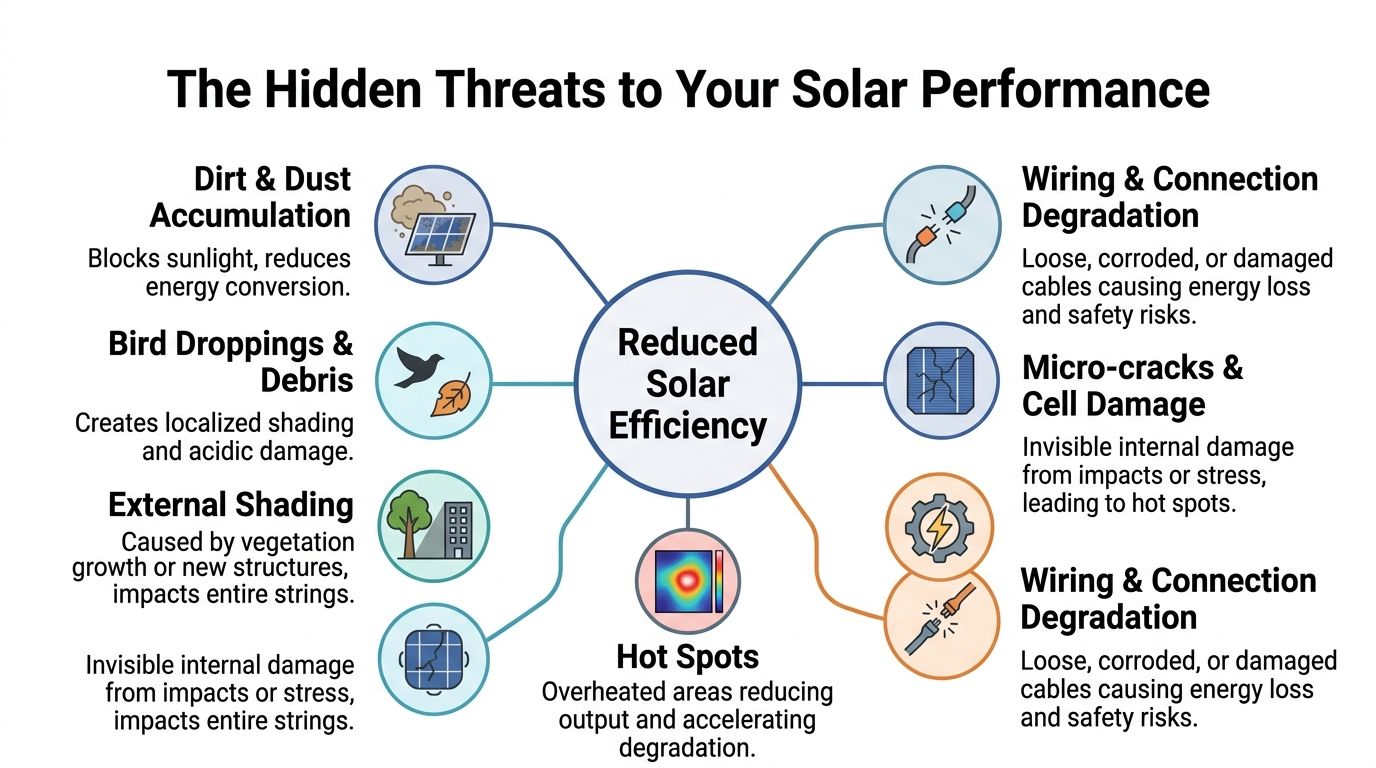
Arizona dust blocks sunlight. That part is obvious. The bigger issue is that commercial roofs rarely collect debris evenly. One string may have runoff marks. A few modules may sit near rooftop equipment. Bird droppings might hit isolated cells while the rest of the panel stays relatively clear.
According to the National Renewable Energy Laboratory material summarized in this area of research, uneven soiling on commercial photovoltaic arrays, including isolated bird droppings or dust streaks, can create localized hot-spot failures that permanently degrade module performance and cause thermal damage to the cell structure, as explained in this hot-spot failure reference.
A useful way to think about it is a clogged artery. The system still tries to push current through, but the restricted area heats up instead of producing power efficiently.
Three different maintenance jobs
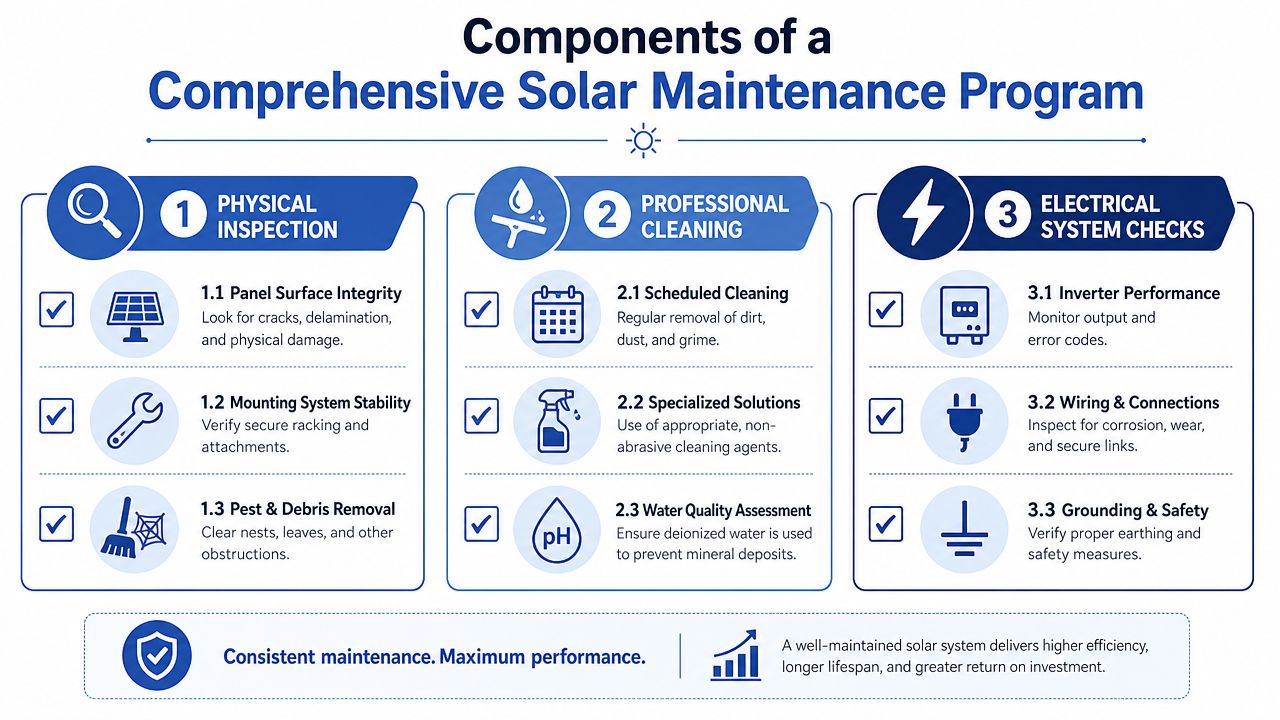
Property managers often group everything under “solar maintenance,” but three separate jobs are involved, and each has a different purpose:
- Surface cleaning: Removes dust, pollen, droppings, and residue that block light or create uneven shading.
- Visual condition review: Looks for cracked glass, frame issues, loose mounts, nesting activity, and signs that water runoff is creating repeat contamination.
- Electrical diagnostics: Checks inverter behavior, wiring integrity, and production patterns that a cleaning crew can't verify by sight alone.
If you want a quick primer on how contamination affects production, this overview of solar panel efficiency loss is a practical place to start.
What rain does not fix
Managers sometimes assume a storm handled the cleaning for free. In Phoenix, that's unreliable. Rain can move dust around without fully removing it, and it can leave a film that bakes back onto the glass.
A panel can look “rinsed” from the parking lot and still be underperforming where it counts.
That's why a maintenance plan has to account for both visible dirt and hidden failure points. Surface cleanliness affects output. Uneven soiling affects equipment health. Inverter and wiring issues affect whether the power gets converted and delivered the way it should. Treating those as one vague problem is where avoidable losses start.
Components of a Comprehensive Maintenance Program
A Phoenix property can have clean-looking panels from the ground and still be losing production, carrying a wiring issue, or baking on residue that shortens the gap before the next service call. For the small-to-mid-scale commercial sites that sit in the overlooked middle, not utility-scale and not small enough to ignore, the maintenance plan has to be practical, repeatable, and tied to cost control.
Physical inspection on the roof
Start with a roof-level inspection of the array and the surrounding conditions. The goal is not just to spot broken glass. It is to identify repeat problems that keep costing output or create avoidable repair work, such as edge damage, delamination, loose clamps, pest activity, drainage patterns that dump dirt onto the same row, and rooftop equipment that throws extra dust or grease onto nearby modules.
EvoEnergy recommends annual inspections for commercial solar systems, with more frequent reviews for larger systems or harsher operating conditions, in its guidance on commercial solar maintenance intervals. In Arizona, that harsher-condition exception matters. A low-rise office near a busy road in Phoenix does not foul at the same rate as a cleaner suburban site, and the inspection plan should reflect that.
Many mid-market properties incur unnoticed financial losses. The issue is not one catastrophic failure. It is the same minor defect or repeat contamination pattern going unaddressed for months.
Professional cleaning with the right method
Cleaning is the labor line item managers notice first, so it needs to be done in a way that protects output and avoids creating the next problem. On commercial arrays, the method matters as much as the visit count. Hard water leaves spotting. Aggressive brushes can scratch surfaces. Poor runoff control can move debris from one section of the array to another instead of removing it.
For facility teams comparing methods in the field, this guide to solar panel cleaning tools is useful because it shows which tools fit panel surfaces and which shortcuts tend to leave deposits or cause wear.
Here is the practical trade-off:
| Maintenance choice | What works | What doesn't |
|---|---|---|
| Water quality | Demineralized or pure water helps avoid mineral spotting | Hard water can leave deposits behind |
| Surface contact | Soft, non-abrasive tools and controlled technique | Aggressive scrubbing can damage surfaces |
| Scheduling | Cleaning based on site conditions and monitoring | Waiting for visible grime or complaints |
Managers also benefit from comparing predictive and preventive maintenance. That distinction applies directly to solar. Preventive work covers scheduled cleaning and routine visual checks. Predictive work uses production trends, inverter alerts, and inspection findings to catch underperformance before it shows up as a larger revenue loss.
Later in the process, this walkthrough is worth watching for field context:
Electrical health checks by the right trade
The final piece belongs to qualified electrical personnel. A cleaning crew can document visible issues and flag irregularities, but inverter diagnostics, connector inspection, thermal imaging, and electrical testing need the right license, scope, and safety process.
SolarEdge notes in its solar system maintenance guide that periodic professional inspection is part of proper system care, including a more technical review on a multi-year interval. For a commercial property manager, the business case is straightforward. Cleaning gets light back onto the glass. Electrical checks confirm the system is successfully turning that sunlight into billable performance.
That division of labor keeps the program effective instead of cosmetic.
Calculating Your Optimal Cleaning Frequency and ROI
A Phoenix property manager approves a solar project to cut operating costs. Six months later, production is off target, the tenant improvement work next door has coated the roof in dust, and nobody can say whether the array needs cleaning now or can wait another quarter. That is where a lot of small and mid-sized commercial properties lose money. The system is too large to ignore, but not large enough to get utility-scale attention.
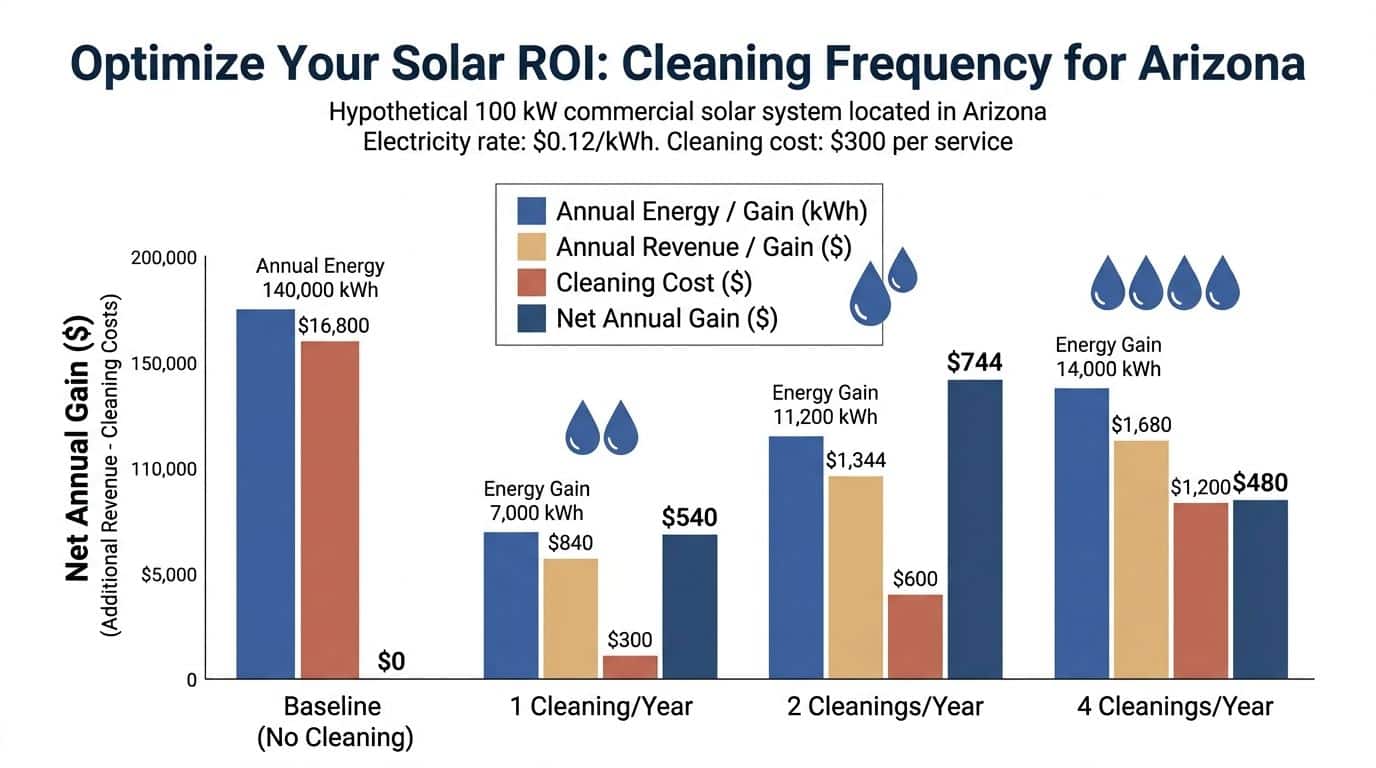
For Arizona sites, cleaning frequency is an operating decision. It should be tied to recoverable production, site exposure, and service cost.
Set a site-specific baseline
For the overlooked middle, broad advice like "clean once or twice a year" is usually too generic to be useful. A one-story office in a cleaner business park does not foul at the same rate as a warehouse near truck traffic, open desert, or active construction.
A practical starting point in the Valley looks like this:
- Twice per year: Lower-soiling sites with limited dust sources and clean drainage patterns.
- Quarterly: The right baseline for many Phoenix-area retail, office, and light industrial properties.
- More often than quarterly: Sites dealing with frequent dust storms, heavy roadside grime, bird pressure, or recurring fallout from nearby operations.
The reason is simple. Arizona does not give panels much help from rainfall, and dust loading is rarely consistent across a full year. In my experience, shoulder seasons and monsoon-related dust events can change the economics fast on exposed roofs.
Colite states in its solar panel cleaning and maintenance best practices that high-dust and high-pollution locations may require cleaning every three months or even monthly, and that rain is not enough to keep panels performing well. That lines up with what crews see on commercial roofs across metro Phoenix.
Use a simple ROI test
Property managers do not need a complex model to set frequency. They need a repeatable way to decide whether the next cleaning visit pays for itself.
Use this process:
- Check recent production against expected seasonal output.
- Rate the property's exposure to dust, traffic film, pollen, bird droppings, and roof runoff.
- Estimate the cost of waiting if soiling continues for another month or quarter.
- Compare that loss to the price of a scheduled cleaning visit.
- Reset the schedule if the same site keeps slipping between service dates.
That approach works especially well for smaller commercial arrays, where a few underperforming months can wipe out the savings from stretching service intervals.
Daily or weekly monitoring also matters here, not as a technical talking point, but as a management tool. Analysts at DataIntelo note in this commercial solar maintenance market report that routine monitoring is becoming standard practice in commercial maintenance. For a property manager, that means less guessing. If output drops after dust events and rebounds after cleaning, the schedule is telling you what it should be.
What usually drives the right schedule in Arizona
Roof conditions decide more than panel count does.
A medical office with limited rooftop debris may hold its performance on a semiannual cycle. A small distribution building near arterial traffic may justify quarterly service all year. A neighborhood retail center with birds roosting on parapets can need spot cleaning between regular visits because droppings do not behave like general dust. They create concentrated shading and leave residue that gets harder to remove if it bakes on.
The cheapest schedule on paper often turns into the most expensive one in practice. Missed production adds up, often going unnoticed, especially on properties that already run tight margins on common-area power costs.
For most small-to-mid-scale commercial systems in Phoenix, the best schedule usually lands between semiannual and quarterly service. The right answer comes from site conditions and production history, not from a generic national rule.
If you need to turn that decision into a budget line, this breakdown of the cost to clean solar panels for commercial properties is a useful reference for comparing service frequency against expected recovery.
Budgeting for Professional Solar Maintenance
A Phoenix property manager usually sees the budget problem the same way at first. Cleaning looks optional until a dusty quarter, a bird issue, or a missed service visit shows up in production and the savings model starts slipping.
That is why solar maintenance belongs in the operating budget, not in a catch-all repair bucket. For small-to-mid-scale commercial properties, especially the overlooked middle of medical offices, retail strips, and light industrial buildings, the goal is straightforward. Keep production predictable, control roof-access risk, and avoid paying premium rates for last-minute service.
Annual cost can be modest on a simple site, but no serious budget should rely on a generic national figure. Pricing changes fast based on how the roof is built, how crews access the array, how much dust the site takes on, and whether the scope includes only cleaning or also inspection notes, photo documentation, and issue escalation.
What changes the quote
Two systems with the same panel count can price very differently.
A low-rise office with clear ladder access, limited rooftop obstructions, and light debris is faster to service than a taller building near traffic corridors or construction zones. In Arizona, dust load, parapet design, bird activity, and roof layout often affect cost as much as system size does.
The quote usually moves on these factors:
- Access and safety requirements: Building height, tie-off needs, ladder placement, and restricted access windows all affect labor time.
- Array layout: Split arrays across multiple roof sections take longer than one clean, open block of panels.
- Soiling conditions: General dust is one thing. Baked-on droppings, pollen buildup, and runoff staining take more time and more care.
- Scope of work: Cleaning only costs less than a visit that also includes condition reporting, photo logs, and documentation for ownership or facilities teams.
- Service agreement terms: Recurring visits usually price more predictably than one-off calls after performance drops.
For budgeting, that last point matters. Planned service is easier to control than reactive service.
Budget for cost per visit and cost of delay
The mistake I see most often is focusing only on the invoice amount. The better question is what happens if service gets pushed back 60 or 90 days during peak dust periods.
On a small-to-mid-scale commercial site, delayed cleaning can cost more than the visit itself if production losses stack up during high-irradiance months. That is the business case in Arizona. You are not just buying washed glass. You are buying recovered output, fewer surprise calls, clearer documentation, and less chance that a minor issue sits on the roof unnoticed.
Cheap bids can also create avoidable cost. Poor water quality leaves mineral residue. Inexperienced crews can track dirt onto membrane roofs, miss problem areas around panel edges, or create access and safety headaches for building staff. A lower number on the proposal does not mean a lower operating cost over the year.
The practical budgeting approach is to compare vendors by scope, site fit, and execution discipline. Look at what is included per visit, how findings are documented, who handles escalation if damage or electrical concerns are spotted, and whether the schedule fits the site's actual dust exposure. That gives property managers a maintenance line item they can defend, instead of a number that only looked good at bid time.
Your Vendor and Contract Selection Checklist
A lot of vendor decisions go wrong for one reason. Managers buy solar maintenance as if it were a commodity. It isn't. The risk profile changes when crews are on roofs, around electrical equipment, and responsible for a revenue-producing asset.

What to verify before signing
A commercial contract should answer operational questions clearly. If it doesn't, the property manager is carrying the uncertainty.
Use this checklist:
- Insurance coverage: Ask for proof of liability coverage and confirm it's current. For many commercial clients, a vendor carrying a $2 million insurance policy provides a meaningful level of protection because roof work and commercial access carry real exposure.
- Safety training: Crews should be trained for ladder work, roof movement, and jobsite safety. “We've done this before” isn't a safety program.
- Water and tools: Ask what water system is used and what touches the panel surface. Pure-water systems and non-abrasive tools reduce the chance of mineral residue and avoidable surface wear.
- Scheduling reliability: Commercial service needs documented scheduling, not informal text-message coordination.
- Scope boundaries: The contract should state what the cleaning vendor handles and what gets referred to a licensed electrician.
- Reporting: You want service records, notes on visible concerns, and a clear trail for warranty or owner review.
The cheapest option is often the least controlled option
One common assumption is that any window cleaner can wash solar panels the same way. That's not how commercial sites work. Roof access, panel-safe methods, and documentation matter. Another assumption is that “gentle” always means effective. It doesn't. A crew can be cautious and still leave a dust film behind if the water quality and technique are wrong.
A practical commercial vendor should also fit into your broader building operations. South Mountain Window Cleaning, LLC is one example of a Valley contractor that offers solar panel cleaning alongside commercial exterior services, uses pure-water systems, carries documented insurance, and works with computerized scheduling for commercial clients. Those details matter because consistency is part of risk control.
If a vendor can't explain their process in plain language, they probably can't defend it when a problem shows up later.
Contract language that helps managers
Look for contract terms that reduce ambiguity:
| Contract point | Why it matters |
|---|---|
| Defined cleaning frequency | Prevents the service from drifting into “as needed” neglect |
| Access and safety procedures | Clarifies site responsibilities and roof protocols |
| Documentation after each visit | Supports owner reporting and maintenance history |
| Escalation path for defects | Ensures visible electrical or structural concerns don't get ignored |
A solid contract should make the decision easier six months from now, not just on signing day.
The Smart Manager's Maintenance Strategy
The most effective solar managers don't treat maintenance as a reluctant spend. They treat it as part of system operations. That shift changes everything, because the goal stops being “clean it as cheaply as possible” and becomes “keep the asset producing the way it was supposed to.”
For Arizona properties, that approach is especially important. Dust exposure, dry conditions, and recurring debris pressure make passive maintenance a losing bet. Small-to-mid-scale commercial sites feel that pain quickly because they often don't have a dedicated solar operations team watching every dip in output. The system may still be on. It just isn't earning at its full potential.
The practical strategy is straightforward:
- Match cleaning frequency to site conditions
- Use monitoring to catch drops early
- Separate cleaning work from electrical diagnostics
- Choose vendors like you're managing risk, not buying a commodity
- Keep records that support warranty, budgeting, and ownership reporting
That's what commercial solar panel maintenance looks like when it's done with business discipline. It protects output, lowers the odds of surprise failures, and keeps the original investment thesis intact.
If you manage property in Phoenix, Scottsdale, Paradise Valley, Chandler, Tempe, Gilbert, or nearby Valley markets, proactive solar care isn't extra. It's part of protecting the return you already paid to install.
If your commercial property needs a practical solar maintenance plan, South Mountain Window Cleaning, LLC can help you evaluate cleaning frequency, roof access considerations, and service scheduling for Arizona conditions. Request a quote to build a maintenance routine that supports production, documentation, and long-term asset performance.