
You're probably looking at a property calendar that already feels crowded. Tenants want clean glass, ownership wants tighter budgets, and every vendor says your building is “easy access” until they show up and start adding exceptions for courtyards, breezeways, shaded elevations, and sun-baked glass on the west side.
In Phoenix, building height only tells part of the story. A low rise building may be easier to reach than a tower, but it often spreads maintenance across more walkway frontage, more roofline, more landscaping edges, and more resident-facing glass. That changes how window cleaning, pressure washing, and routine exterior care should be planned.
Property managers who treat low-rise maintenance like a smaller version of high-rise maintenance usually end up with uneven results. The better approach is to match the cleaning plan to the building type, the site layout, and the Valley's dust and sun exposure.
Why Your Building Classification Matters for Maintenance
A building classification isn't just an architectural label. For maintenance teams, it tells you how people access the exterior, what safety setup is needed, how long service should take, and where costs usually drift if the plan is loose.
Phoenix managers feel this fast. A three-story garden-style apartment community doesn't need the same rigging as a downtown tower, but it can be harder to maintain consistently because the footprint is wider, the resident touchpoints are more frequent, and crews have to work around parked cars, shaded entries, pool decks, dog areas, and pedestrian traffic.

That matters even more now because the demand for low-rise properties is surging, with industry reports noting a 40% increase in low-rise residential projects in 2025, yet practical maintenance guidance for these properties hasn't kept pace. More low-rise product is coming online, but many managers are still using vendor scopes built for either single-site retail or true high-rise assets.
A stronger plan starts with a practical checklist. If you manage multiple exterior tasks across the year, a commercial building maintenance checklist helps organize windows, walkways, facade washing, drainage points, and seasonal touchups into one operating rhythm.
What classification changes on the ground
The biggest shift is access. In a low rise building, crews usually work with ladders, water-fed poles, hose management, and ground-based equipment. That sounds simpler, but the site often adds friction.
- Longer travel paths: Crews spend time moving between wings, detached structures, leasing areas, and amenities.
- More interruption points: Residents, deliveries, grounds crews, and maintenance carts all affect staging.
- Different dirt patterns: Phoenix dust settles heavily on lower glass, sills, railings, and entry glass that tenants notice first.
Practical rule: The right maintenance plan follows the property's footprint, not just its floor count.
Why managers run into trouble
Low-rise properties get underestimated. A vendor may bid only for visible glass and forget stair towers, clubhouse transoms, breezeway glass, gate enclosures, or rear elevations facing service alleys. The result is a property that looks clean from the leasing office but inconsistent everywhere else.
Classification helps prevent that. Once you know what kind of building you're maintaining, you can scope work more accurately, schedule it with fewer disruptions, and avoid paying for reactive cleanup that should have been handled proactively.
What Is a Low Rise Building
A low rise building has a specific technical meaning, and that definition affects maintenance more than most owners expect. A low-rise building is technically defined as an enclosed structure with 1 to 4 stories and a height below 35 meters (115 feet), which allows for simplified structural systems and can reduce construction costs by 20–30% compared to taller buildings.
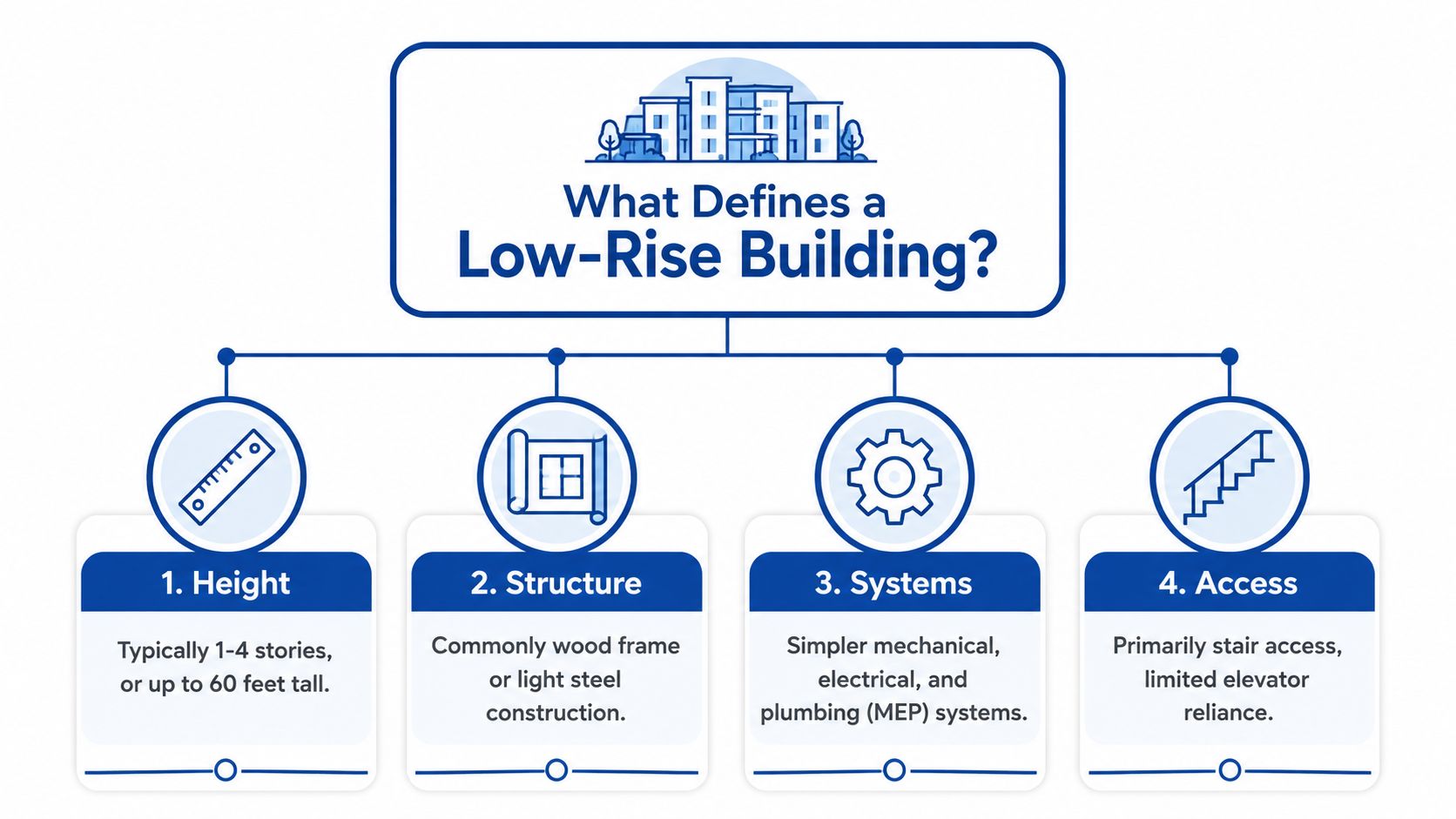
That sounds like a design fact, but it has direct maintenance consequences. Buildings in this range usually rely on simpler structural and vertical systems. You'll often see more direct stair access, less dependence on elevators, and easier perimeter reach for exterior crews. Simpler doesn't mean effortless. It means the work is distributed differently.
Think of it like a vehicle choice
A low rise building is like a sedan used every day. It's versatile, easier to park, and efficient for most tasks. A high-rise is more like a freight truck. It handles a very different job, but it needs specialized systems, more planning, and tighter operating controls.
That comparison helps managers make sense of the trade-off. The sedan is easier to use, but if you have five buildings, detached garages, and long walkways, you still need a disciplined route and maintenance schedule. Low-rise properties reward organization more than brute equipment.
A short visual can help clarify how the category works in practice.
What the definition means for operations
The height limit usually changes four practical things for a property manager:
Access is more direct
Crews can usually reach much of the exterior from the ground or with light access equipment. That reduces complexity, but only if the site is laid out well and the contractor plans hose routes, ladder placement, and tenant protection.The footprint often gets larger
Instead of stacking more space vertically, developers spread units and common areas across the site. That creates more corners, more facade transitions, and more square footage of sidewalk and entry work.The tenant experience becomes more visible
In low-rise communities, residents walk past glass, stair rails, breezeways, and entry doors every day. Small lapses in maintenance show up faster because they're at eye level.Scheduling can be more flexible
You usually don't need tower-specific access windows or shutdown coordination. But you do need to avoid peak move-in days, trash pickup conflicts, irrigation cycles, and resident-heavy amenity hours.
Low-rise maintenance works best when the vendor thinks like a site operator, not just a cleaner.
Where managers misread the category
Some people hear “one to four stories” and assume every low-rise asset is low risk, low hassle, and low cost to maintain. That's not how it plays out in Phoenix. Sun exposure, stucco texture, hard water, irrigation overspray, and airborne dust can make a newer low-rise building look tired well before the owner expects it.
The useful takeaway is simple. A low rise building gives you more straightforward access than a tower, but it also demands better coverage planning because so much of the exterior is spread horizontally instead of stacked vertically.
How Low Rise Buildings Differ from Taller Structures
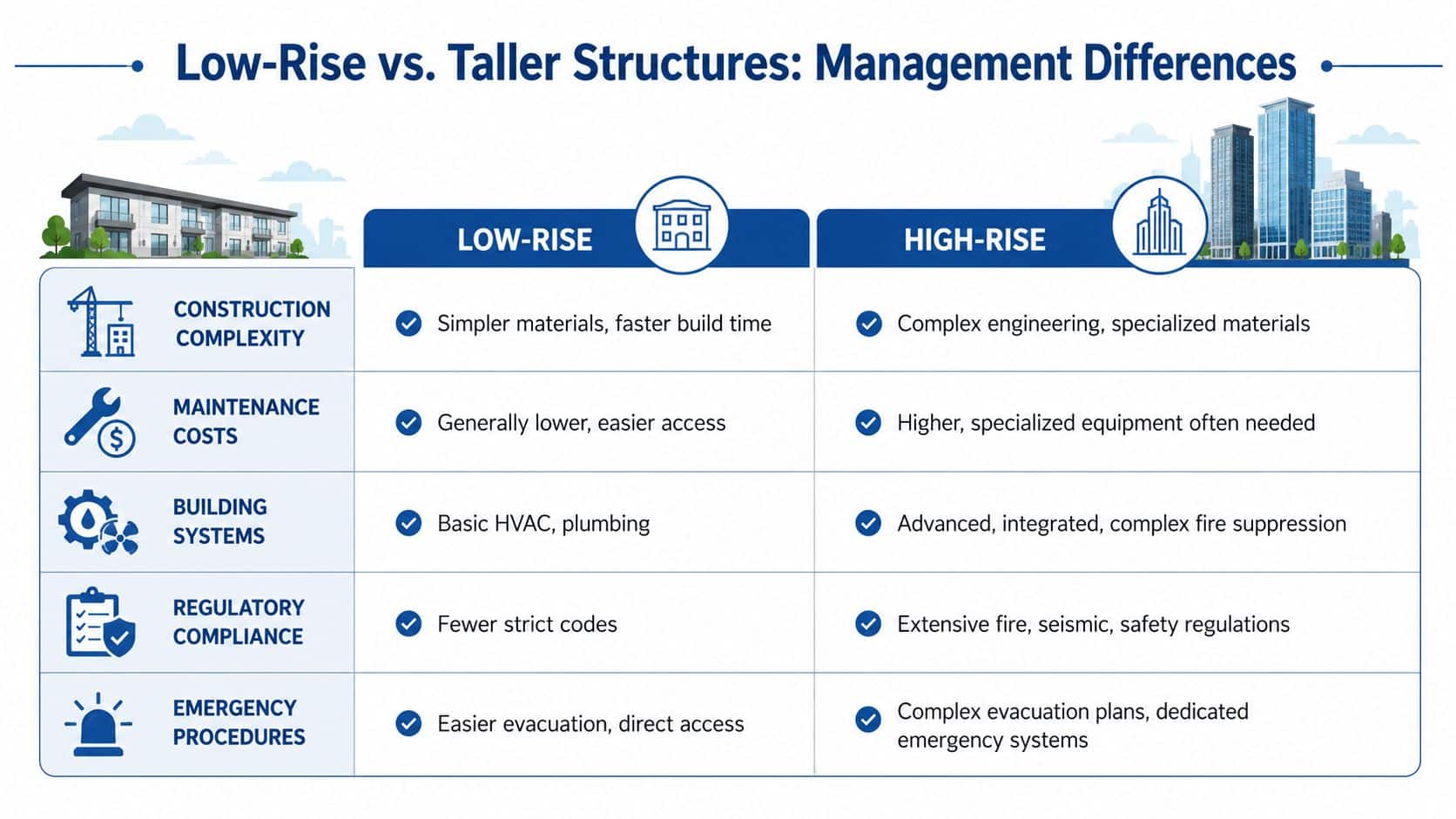
The biggest difference between low-rise and taller buildings isn't just floor count. It's how maintenance work moves across the property.
High-rise cleaning is dominated by vertical access. Low-rise cleaning is dominated by route planning, perimeter coverage, and repeated setup across many smaller zones. One building asks, “How do we reach the glass safely at height?” The other asks, “How do we cover the entire site efficiently without missing the details tenants see every day?”
The maintenance differences that actually matter
Here's where the two building types separate operationally.
| Factor | Low-rise properties | Taller structures |
|---|---|---|
| Exterior access | Ground-based tools, ladders, poles, sectional routing | Rope access, lifts, swing stages, tighter drop planning |
| Work interruptions | Residents, cars, courtyards, leasing traffic | Loading zones, street permits, facade access restrictions |
| Surface spread | Wider footprint, more entries and walkways | More vertical repetition, less horizontal spread |
| Scheduling | Easier to phase by building or wing | Often depends on access windows and specialized crew timing |
For many managers, low-rise work feels easier because the equipment is less specialized. That's only partly true. Ground access reduces one type of complexity and introduces another. A crew can reach the glass, but they still need to protect landscaping, avoid leaving hoses across active paths, manage resident traffic, and clean in a sequence that keeps the property presentable throughout the job.
Efficiency doesn't mean identical upkeep
Low-rise buildings also tend to be more efficient operationally in ways that shape maintenance expectations. Benchmark data shows low-rise structures consume 30–40% less energy per square foot than high-rise buildings, due to factors like optimized orientation and less complex vertical systems. That often aligns with ownership goals around simpler operations and tighter recurring costs.
But lower systems complexity doesn't mean exterior work can be casual. It means managers should expect a maintenance program that is simpler in equipment, not sloppier in execution.
If you manage both asset types, it helps to compare low-rise needs against a true tower program such as high-rise window cleaning services. The gap in access method, safety planning, and job sequencing is substantial.
What works and what doesn't
Some practices transfer well across building types. Others don't.
What works on low-rise sites
- Zone-based scheduling: Clean by building cluster, frontage, or elevation so residents and staff can follow progress.
- Ground-safe tools: Water-fed poles, pure-water systems, soft wash methods, and surface cleaners fit the access profile well.
- Bundled exterior service days: Windows, flatwork, and entry cleanup done together reduce repeat disruption.
What doesn't work well
- Tower-style pricing logic: Charging as if height is the only difficulty misses the labor tied to spread-out layouts.
- Loose site walks: If the contractor doesn't map courtyards, rear elevations, and amenity zones, missed areas are almost guaranteed.
- One-size-fits-all frequencies: A shaded north side and a street-facing west side won't collect dirt the same way.
The lower the building, the more the maintenance plan depends on the property map.
Taller buildings concentrate complexity upward. Low-rise properties spread it outward. That's why the right contractor for a low rise building needs strong field discipline, not just the ability to reach second- and third-story glass.
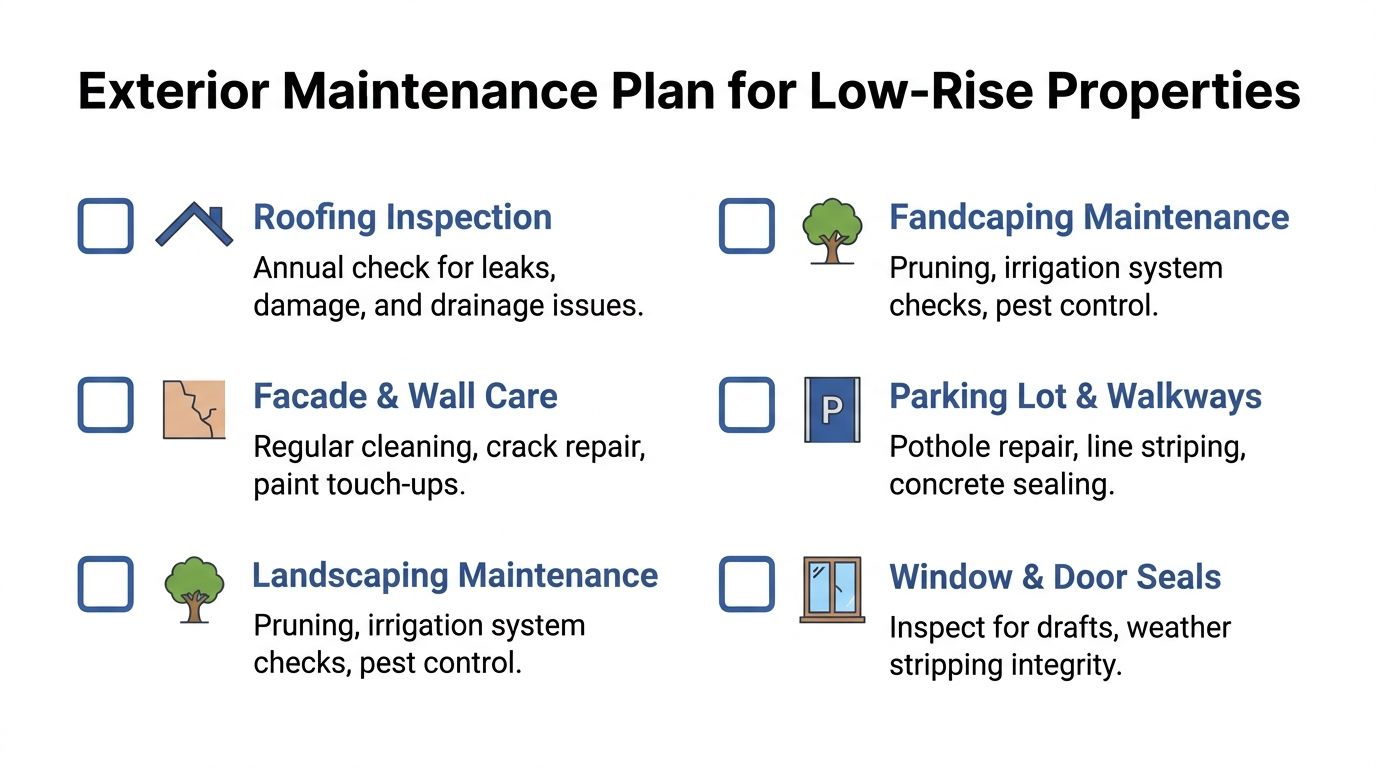
Your Exterior Maintenance Plan for Low Rise Properties
A good low-rise maintenance plan is built around exposure, traffic, and repeatability. In Phoenix, the goal isn't only to make the property look clean after service day. It's to keep it looking controlled between visits, even with dust, sun, irrigation overspray, and constant use of common areas.
Start with windows because tenants notice them first
Window glass is the quickest visual signal of whether a property is being maintained well. In the Valley, that signal degrades fast. In Phoenix, Arizona's dry and dusty climate, professional window cleaning typically removes 15–25% more particulate buildup than in humid coastal regions, which supports a quarterly cleaning cycle to maintain glass clarity and curb appeal.
Quarterly is a solid baseline for many low-rise communities and commercial sites, especially where buildings face open roads, new construction, parking lots, or desert-edge winds. On some properties, storefront entries, leasing offices, fitness rooms, and pool-facing glass need more attention than upper residential panes because fingerprints, dust film, and sprinkler spotting show immediately.
Best practice for low-rise window routes
- Front-facing first: Clean leasing, lobby, storefront, and clubhouse glass early in the service window so the property looks improved right away.
- Use water-fed poles where they make sense: They reduce ladder movement, limit ground disruption, and work well on reachable upper glass.
- Detail the lower glass by hand: Entry doors, sidelights, and tenant-facing panels usually need squeegee work and frame wipe-downs for a finished look.
A lot of managers also pair their glass service with pressure washing for commercial buildings because dirty walkways and splashed lower walls make clean windows stand out in the wrong way.
Treat walkways and common areas as a separate system
Low-rise properties have more horizontal hardscape. That means more places where dust, gum, beverage spills, leaf debris, and grime collect along daily travel paths. Sidewalks around mail kiosks, pool gates, dumpster enclosures, breezeways, and retail pads usually age faster than building facades.
A practical plan separates these areas into categories:
| Area | Main issue | Maintenance approach |
|---|---|---|
| Main entries | Foot traffic residue, dust, spills | Frequent spot cleaning and scheduled washing |
| Walkways and breezeways | Dust film, cobwebs, splash marks | Recurring rinse or wash cycles |
| Dumpster and service zones | Odor, staining, residue | Targeted sanitation and surface cleaning |
| Pool and amenity decks | Sunscreen residue, dirt, water spotting | Careful cleaning with tenant safety in mind |
Bundling offers a clear advantage. If the crew is already on site for glass, adding adjacent flatwork, entry overhang cleanup, and touchpoint rinsing usually creates a more consistent result than spreading tasks across separate vendors.
Field note: On low-rise sites, the dirtiest surfaces are often the ones nobody scopes clearly. Side gates, rear sidewalks, enclosure walls, and breezeway corners are where a property starts looking neglected.
Don't ignore drainage edges and roofline details
Gutters and roofline runoff don't get as much attention as glass, but they affect building appearance and long-term wear. Low-rise properties often have broad roof spans and multiple roof sections feeding walkways, entries, and planting beds below. If drainage points clog or overflow, you'll see staining, splashback, and concentrated dirt lines on stucco and concrete.
Managers don't need a complicated engineering plan here. They need routine observation.
- Check roof edges after storms: Debris buildup often shows up first at downspout exits and splash zones.
- Watch for streaking on facade sections: It usually means runoff is carrying dirt repeatedly over the same wall.
- Coordinate gutters with facade cleaning: Handling both on a similar schedule prevents one neglected area from undoing the visual impact of the other.
Build the schedule around the property, not the contract
The best plans match service frequency to exposure.
A shaded interior courtyard doesn't load dust like a street-facing elevation near traffic. West-facing glass bakes on residue. Irrigation-heavy landscaping can leave spotting on first-floor panes and stucco bases. Restaurant pads, pet relief areas, and heavily used amenities need more frequent touchups than quiet residential wings.
That's why low-rise scheduling should be map-based. Break the property into visible public zones, tenant zones, and back-of-house zones. Then service each one at the cadence its use demands. That approach controls cost better than over-cleaning low-impact areas and under-cleaning the surfaces residents complain about most.
Hiring a Professional Cleaning Contractor in Phoenix
The wrong contractor usually doesn't fail on day one. The problems show up later. Missed elevations. Inconsistent routes. Poor hose control. No clear safety process. Thin insurance. Slow communication when a manager asks for updated documentation.
That's why hiring for a low rise building should still be done with commercial standards in mind. Height may be lower, but liability, resident exposure, and property value are not.
Insurance and professionalism matter on every site
A serious contractor should be able to document insurance, explain site safety, and describe how they handle active properties. Professional commercial cleaning contractors carry significant insurance, often a minimum of $2 million per incident, to meet building owner requirements and protect assets from liability, a standard that indicates professionalism regardless of building height.
That number matters because low-rise work still involves ladders, hoses, lift risk on some sites, vehicle exposure, resident traffic, and potential damage to glass, stucco, signage, coatings, and landscaping. A contractor who treats a commercial low-rise site like a casual residential stop is telling you something about how they manage risk.
Questions worth asking before you sign
Ask direct questions. A good vendor won't dodge them.
How do you stage work on occupied properties
You want to hear about cones, hose management, restricted zones, resident awareness, and route planning by building or frontage.What proof of insurance can you provide
Don't accept a verbal answer. Ask for current documentation and verify that commercial work is part of their regular operation.How do you handle scope accuracy
The contractor should walk the site thoroughly and identify entries, breezeways, courtyard glass, detached amenities, rear elevations, and specialty surfaces before pricing.What tools do you use on low-rise sites
Listen for specifics such as water-fed poles, pure-water systems, squeegees, soft wash methods, surface cleaners, and procedures for fragile or heat-exposed surfaces.How do you manage add-ons and missed areas
This tells you whether the company has a real system or improvises after complaints.
For gutter-related planning, it also helps to compare outside perspectives. Prime Gutterworks' expert insights offer a useful reminder that drainage maintenance isn't separate from exterior appearance. Overflow and debris quickly show up as facade staining, walkway mess, and preventable wear.
Don't buy only on price
A low bid can become the expensive option if the contractor underestimates labor, leaves the property half-finished, or creates tenant complaints. Low-rise properties are full of visible details, and every missed pane or dirty breezeway corner is easy for residents to photograph and report.
That's why managers should prioritize consistency, documentation, and communication over bare minimum pricing. A qualified window cleaning company should be able to explain how it will protect your site, maintain quality across multiple buildings, and keep service predictable from Scottsdale to Gilbert, not just promise “clean windows” in a proposal.
If a contractor can't describe the workflow for your property, they probably haven't thought through the work.
Partner with the Experts in Phoenix Exterior Cleaning
Low-rise properties need their own maintenance strategy. The access is easier than a tower, but the sprawl, tenant visibility, dust exposure, and constant use of common areas create a different kind of challenge. Managers who recognize that early usually get better results, fewer complaints, and a cleaner-looking property between service visits.
In Phoenix, that approach matters even more. Sun bakes residue onto glass. Dust settles on lower panes, frames, sills, entries, and walkways. A maintenance plan has to reflect how the property is used, not just how tall it is.
South Mountain Window Cleaning provides residential, commercial, and high rise window washing services in Phoenix, Scottsdale, Paradise Valley, Chandler, Tempe, Gilbert, Arizona. For owners and managers who need dependable exterior cleaning across different property types, experience with both low-rise and taller buildings makes a measurable difference in planning, safety, and finish quality.
If you need a reliable exterior cleaning partner, South Mountain Window Cleaning, LLC serves Phoenix, Scottsdale, Paradise Valley, Chandler, Tempe, and Gilbert with residential, commercial, and high-rise window washing, plus exterior cleaning services built for Arizona conditions. Reach out for a fast, no-obligation quote and a maintenance plan that fits your property's layout, traffic, and exposure.