
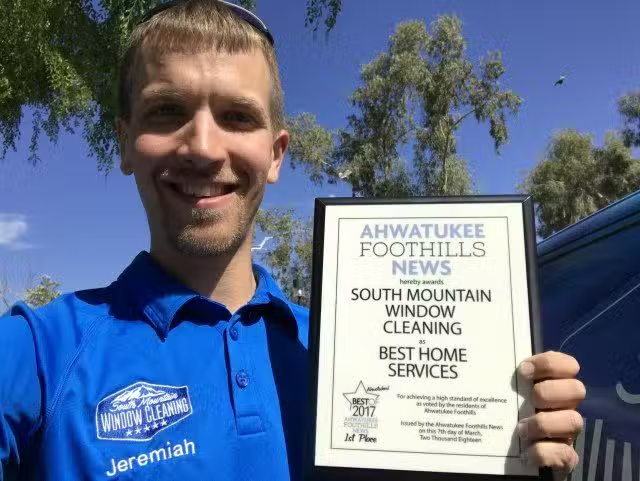
You look up at your panels after a windy week in Phoenix and they don't look terrible. They just look a little dull. A light brown film. Maybe some grit gathered along the lower edge. Maybe a few spots that baked on after a dusty rain.
That's usually how solar output loss starts here. Not with dramatic debris, but with fine desert dust, hard water spotting, and grime that gets cooked onto hot glass. In the Valley, solar panel cleaning isn't cosmetic. It's part of protecting the system you paid for.
A lot of homeowners search for solar panel cleaning tools because they want to handle it themselves, at least at first. That makes sense. But in Arizona, the right tool matters more than people expect. The wrong brush can scratch. Tap water can leave mineral residue. Midday cleaning can turn a simple rinse into a streaked mess. And roof access is where a basic maintenance job can get dangerous fast.
Why Clean Solar Panels in the Valley of the Sun
Phoenix gives solar owners a lot of sunshine. It also gives them some of the toughest panel-cleaning conditions in the country. Dust settles constantly, haboobs can coat an array in one shot, and long dry stretches mean natural rinsing is limited. Add intense heat, and grime doesn't just sit there. It bakes on.
That's why cleaning tools are becoming a much bigger part of solar operations overall. The global solar panel cleaning equipment market is projected to grow from USD 2.501 billion in 2024 to USD 11.24 billion by 2035, a projected 14.64% CAGR over 2026 to 2035, according to Market Research Future's solar panel cleaning equipment outlook. That shift reflects how owners now view cleaning gear. It's not just an add-on. It's part of maintaining output.
Dust in Phoenix isn't a minor issue
In cooler, wetter climates, homeowners can sometimes get away with waiting on rain. That's not how it works here. Fine desert particulates settle into a uniform film that's easy to ignore from the ground but very real on the glass. On some homes, you'll also see caked pollen, bird droppings, or residue left behind by monsoon moisture and blown dirt.
When output slips, many people assume it's seasonal variation. Sometimes it is. Sometimes the panels just need to be cleaned. If you want a closer look at what buildup can do over time, this breakdown of solar panel efficiency loss is worth reading.
Dirty panels don't usually announce themselves. They quietly reduce performance until someone looks closely or compares production over time.
Arizona adds two extra problems
The first is hard water. A hose rinse with untreated tap water often leaves minerals behind, and those spots can become their own layer of residue once the sun dries them.
The second is heat and access. Roof surfaces in Phoenix get brutally hot, and most residential arrays aren't installed where a casual ladder setup makes sense. That changes the DIY equation. A cleaning method that seems simple online can be inefficient, unsafe, or both in local conditions.
For Valley homeowners, the primary question usually isn't whether the panels should be cleaned. It's which tools are safe, which shortcuts should be avoided, and when the job stops being a homeowner task and becomes a professional one.
Assembling Your Essential Solar Panel Cleaning Toolkit
A Phoenix homeowner can do a light panel cleaning with the right gear. The problem is that the wrong gear causes scratches, mineral spotting, or a risky roof setup fast. In our climate, the toolkit matters as much as the effort.
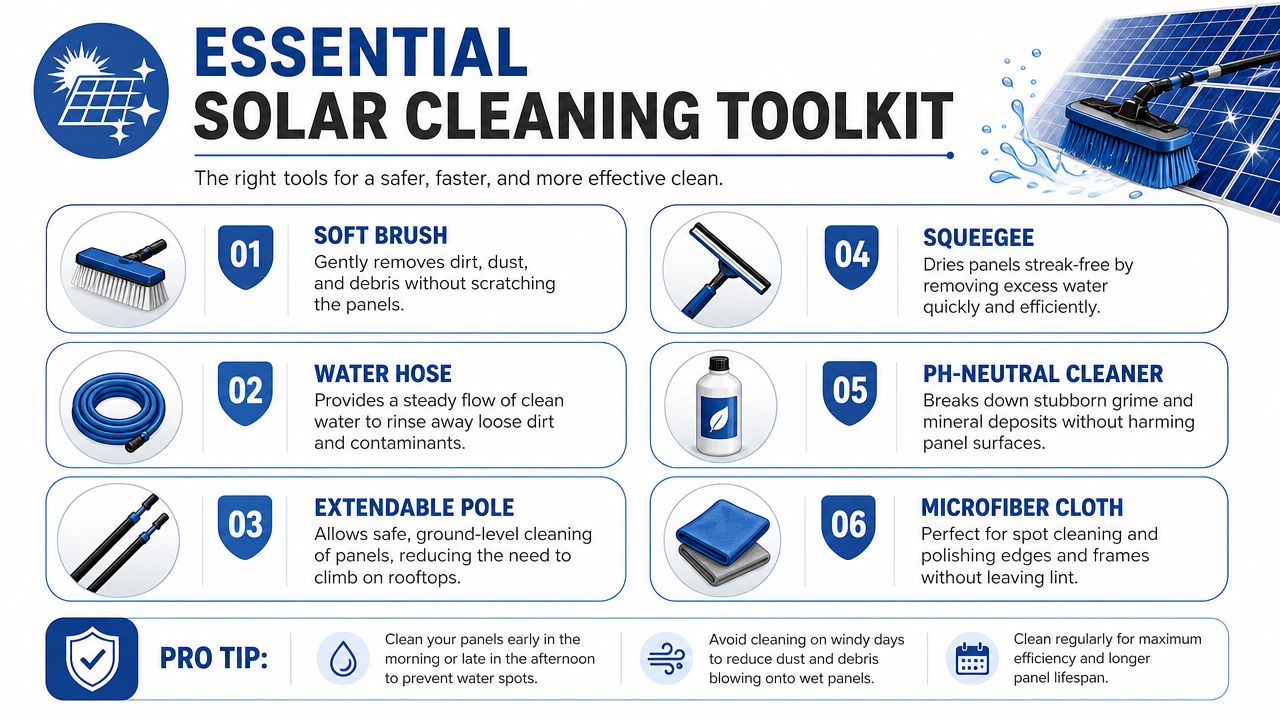
Kärcher's solar and photovoltaic panel cleaning page notes that contamination can cut yield significantly on affected systems. The practical takeaway is simple. Use tools built for coated glass, keep the contact soft, and avoid anything that leaves residue behind.
The tools that earn their place
For a typical single-family home, a basic kit should include:
- A soft solar brush or soft wash pad. Panel glass is durable, but it is still a finished surface. Stiff bristles, deck brushes, and abrasive pads are a bad trade.
- A water-fed pole long enough for your roofline. Reach matters in Phoenix because many arrays sit above tile roofs with awkward access. A proper pole lets you clean from the ground or from a safer working position instead of stepping around hot roof sections.
- Deionized or purified water. This is the big one locally. Phoenix tap water is hard, and a quick hose rinse can leave mineral spots that bake onto the glass.
- Good hose connections and a shutoff valve. Cheap fittings pop loose, leak, and make ladder work harder than it needs to be.
- A brush head that matches the soil load. Dry dust, bird droppings, and monsoon residue do not respond the same way. A soft head with steady water flow handles general buildup better than aggressive scrubbing.
- Basic safety gear. Ladder stabilizers, gloves, eye protection, and non-slip footwear matter. So does knowing when the roof pitch, height, or panel layout puts the job outside DIY territory.
One missing item causes a lot of poor results. Water quality.
In Phoenix, the rinse water can create the next problem
I see this all the time on exterior glass. A homeowner removes the dust, then the sun dries the tap water before the surface clears clean. What is left behind is a light mineral film or spotting. On solar panels, that defeats part of the point of cleaning.
That is why exterior cleaning crews use purified-water systems instead of standard hose water. The same maintenance logic shows up in preventative AC coil cleaning. Clean the working surface without adding residue that hurts performance.
Practical rule: If your hose water leaves spots on your windows, it can leave spots on your panels.
What separates a homeowner kit from a professional setup
A homeowner can usually get by with a soft brush, a decent pole, and purified water if the array is reachable and the roof access is straightforward. A professional setup gets more specialized because the job changes. Taller homes, larger arrays, steeper rooflines, and commercial properties call for carbon-fiber poles, larger DI systems, hose management, and equipment that can keep water quality consistent through the whole job.
The International Window Cleaning Association explains the basics of water-fed pole systems, including why purified water is used on exterior glass and panels. If you want a broader look at the kind of gear pros rely on for exterior work, this guide to what professional window cleaners use gives a useful comparison.
That cost and setup burden is why many homeowners stop at light maintenance and call a pro for anything high, steep, or heavily soiled. One local option is South Mountain Window Cleaning, LLC, which offers solar panel cleaning using pure-water exterior cleaning methods for residential and commercial properties in the Phoenix area.
A Safe and Effective Solar Panel Cleaning Process
Most bad results come from one of two things. Wrong timing or wrong method. In Phoenix, both problems show up quickly because the glass gets hot fast and water evaporates even faster.
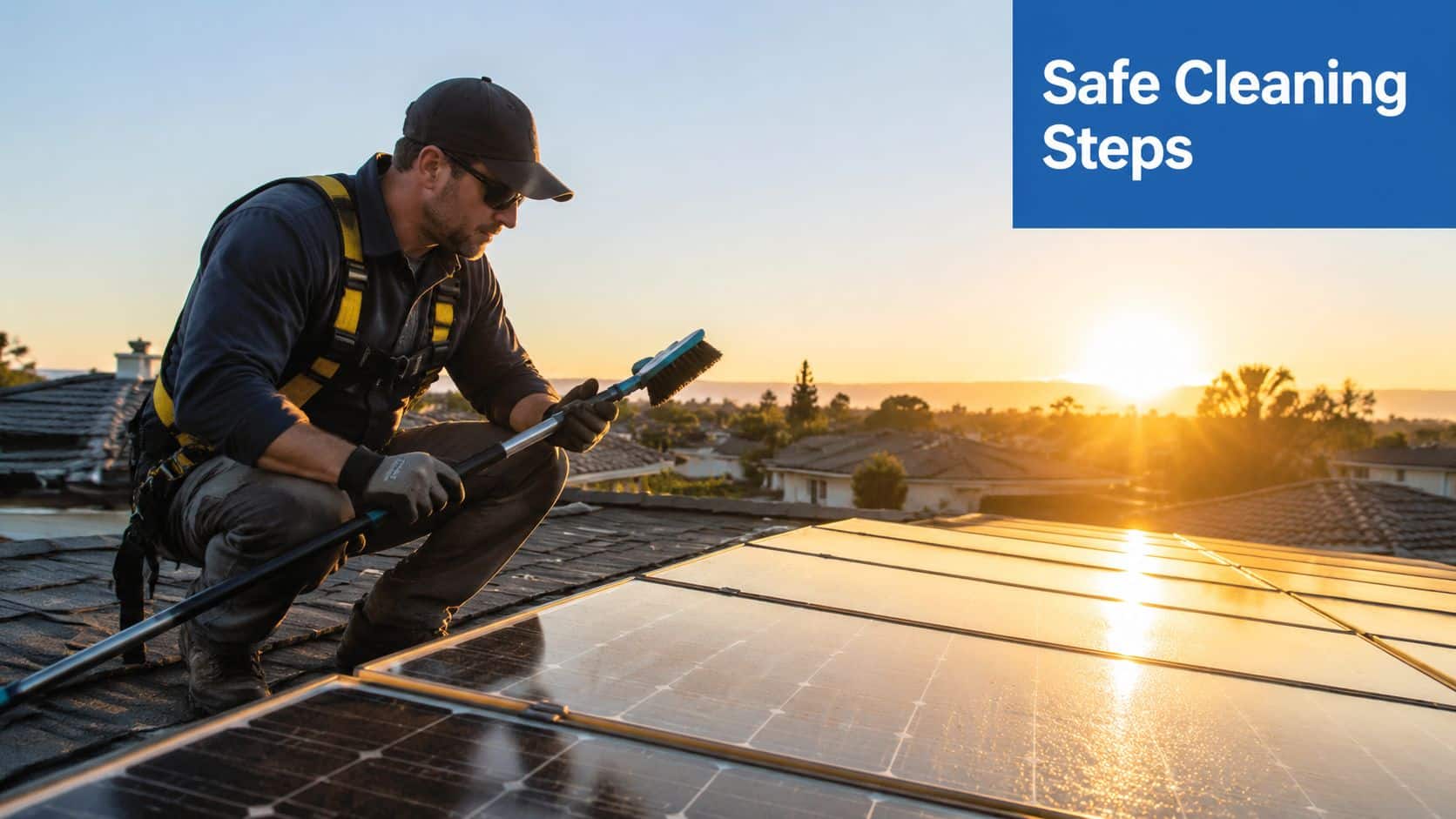
Start when the panels are cool
Early morning is usually the safest window for a residential cleaning. The glass is cooler, the roof is less punishing, and the rinse has a better chance of staying on the surface long enough to do its job.
Before any cleaning starts, do a visual inspection from the ground or from a safe access point. Look for obvious dirt bands, bird droppings, pooled residue near frame edges, and anything that suggests damage or loose hardware. If there's any electrical concern, stop and follow the system manufacturer's and installer's guidance before touching the array.
Use a rinse-and-lift method, not aggressive scrubbing
Professional guidance warns against using a pressure washer because it can damage modules, and wet cleaning is preferred when sticky contaminants are present because it can restore an additional 2–5% efficiency versus dry-only methods in heavily soiled conditions, according to Soilar's guide to solar panel cleaning systems.
That plays out clearly in Arizona. Dry dust can often be loosened with a controlled rinse and a soft brush pass. Bird droppings, pollen, and baked-on residue usually need a wet approach and a little dwell time, not more force.
A sound workflow looks like this:
- Pre-rinse first. Let water carry off loose grit before the brush touches the surface.
- Work top to bottom. Gravity helps you avoid pushing dirty water back over areas you already cleaned.
- Use light contact. The brush should lift residue, not grind it against the glass.
- Flush the edges. Dust and grime often gather along lower frames and corners.
- Finish with a pure-water rinse. That final rinse is what leaves the cleanest surface in our hard-water environment.
Ground-mounted and roof-mounted systems are different jobs
A ground-mounted array is straightforward if you have room to move and safe footing. Rooftop arrays are another story. Tile roofs, pitch changes, second-story access, and tight panel placement all increase the chance of a bad step or incomplete cleaning.
That's also where tool selection matters. If you want a more detailed local overview of methods and service options, this guide to the best solar panel cleaning is useful.
Here's a quick visual example of careful panel-cleaning technique in action:
If you have to walk the roof to “make it work,” the process probably isn't set up correctly for a safe DIY clean.
How Often to Clean Panels in Our Dusty Climate
A Phoenix array can look decent from the ground and still be under a layer of fine dust after one windy week. Then a haboob rolls through, the next light rain turns that dust into spots, and output starts slipping before the system looks obviously dirty.
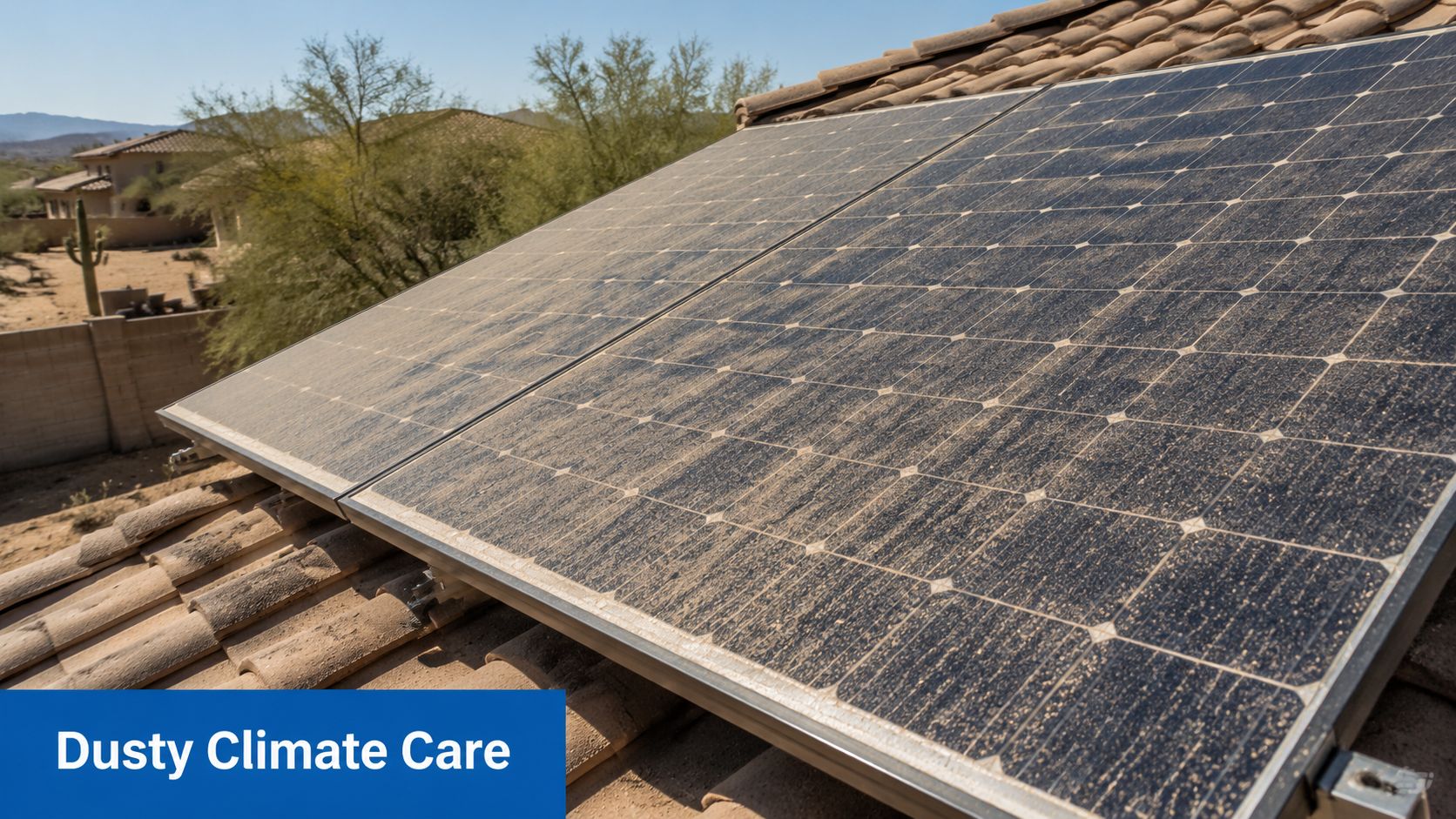
For Phoenix homes, once or twice a year is often too light. The National Renewable Energy Laboratory notes that soiling losses vary by site and climate, which is exactly the issue in the Valley. Dust loads, dry stretches, and dirty rain make local conditions harsher than what a general maintenance schedule assumes. A better rule is to inspect often and expect more frequent cleaning during dusty months.
What a practical Phoenix schedule looks like
Quarterly service is a reasonable starting point for many homes here, especially near open lots, new construction, farm ground, or high-traffic roads. Some systems can stretch longer. Others need attention sooner after major wind events or a long dry spell.
Use the calendar as a baseline, then adjust for what your roof and your surroundings are doing.
- After a haboob or strong wind event. Fine desert dust settles evenly across the glass and can be hard to judge from the ground.
- After dirty rain. In Phoenix, rain often leaves mud residue and mineral spotting instead of giving panels a true rinse.
- During heavy pollen periods. Pollen sticks differently than loose dust and usually needs more than a casual hose-off.
- After extended dry weather. With no meaningful rinse from the weather, buildup gets more stubborn.
Watch the system, not just the calendar
Production monitoring helps, but it should not be the only trigger. A seasonal dip in output can be normal. A visible film, lower-edge grime, bird droppings, or spotty residue after rain points to a cleaning need much faster than waiting for a yearly reminder.
Here is a simple way to check it:
| Check | What to watch for |
|---|---|
| Visual glass check | Dust film, edge buildup, droppings, pollen, dried rain spotting |
| Production review | Output running lower than recent normal under similar weather |
| Weather pattern | Haboobs, windy weeks, dry stretches, dirty rain |
| Location factors | Nearby construction, desert lots, traffic corridors, trees |
One caution from working in Phoenix. Hard water changes the timing decision. If the panels are lightly dusty but the only plan is a midday hose rinse with untreated tap water, waiting for a proper early-morning clean is usually smarter than creating a layer of mineral spots.
Best time of year and time of day
Spring and summer usually bring the most calls because wind, pollen, and heat stack up fast. Morning is still the right window. Cooler glass is safer to work around, and rinse water does not flash off as quickly.
For a small ground-mount system, regular inspections and a simple cleaning schedule can work well. For second-story roof arrays, steep tile, or larger systems, the interval matters less than doing the job safely and with the right water. In Phoenix, plenty of DIY jobs start as dust removal and end with spotting, missed sections, or a risky climb.
Costly Solar Panel Cleaning Mistakes to Avoid
A common Phoenix mistake goes like this. Panels look dusty after a windy week, the roof is already hot by late morning, and someone heads up with a hose, a scrub brush, and whatever soap is under the sink. The dust comes off. The mineral spots, streaks, and roof risk show up right after.
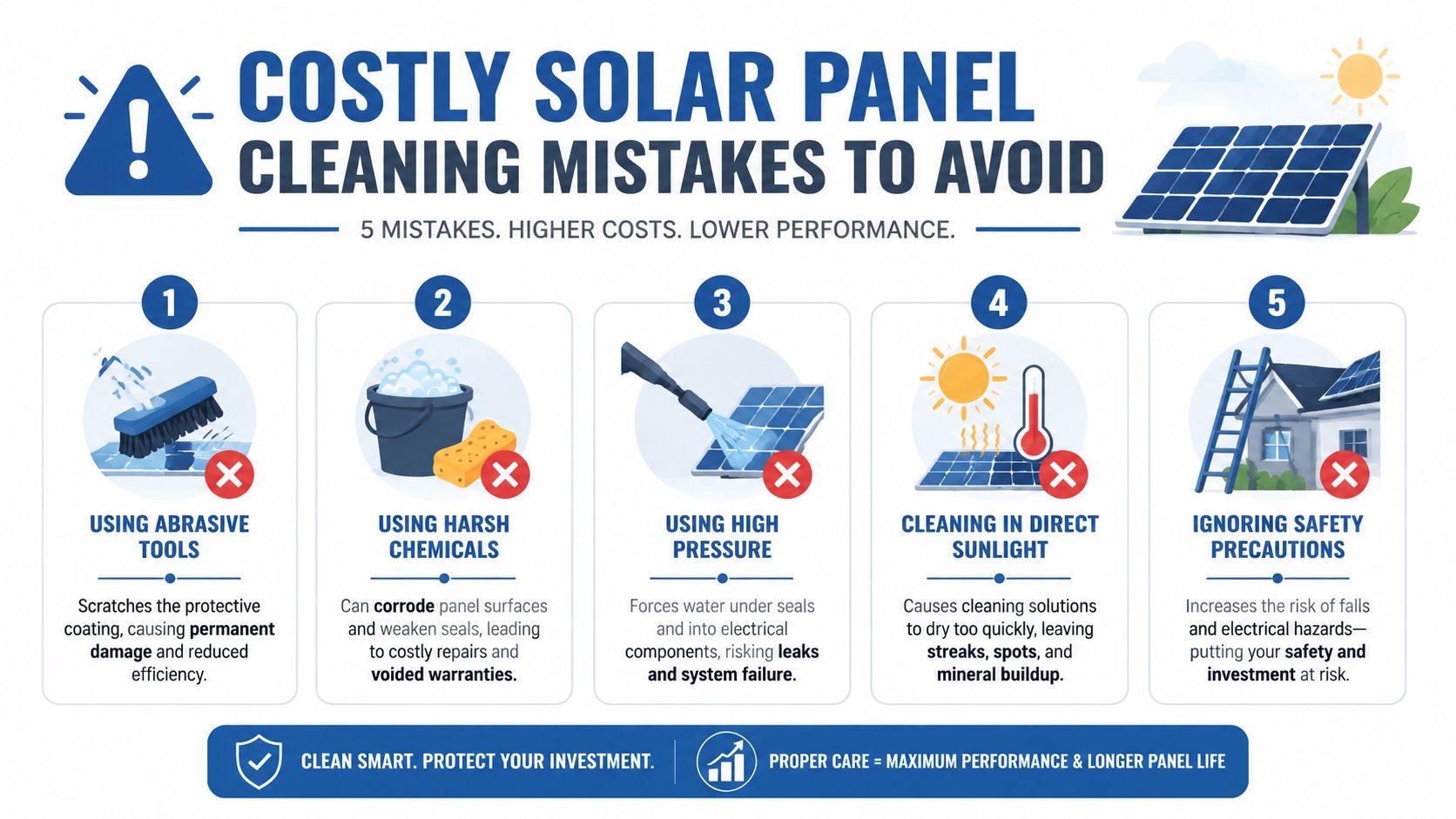
In the Valley, bad cleaning habits usually cost more than the dirt itself. Heat speeds up evaporation, hard water leaves deposits fast, and desert grit turns the wrong brush into a surface-wear problem.
The shortcuts that backfire
Some errors hurt performance. Others create safety issues or avoidable repair costs.
- Using a pressure washer. Solar panels are not a driveway or block wall. High pressure can force water into places it does not belong and can damage seals, frames, or electrical components.
- Scrubbing with stiff brushes, abrasive pads, or razor tools. Arizona dust often includes fine sand. Pair that with an aggressive tool and you can grind debris across the glass instead of lifting it away.
- Rinsing with untreated tap water in direct sun. Phoenix water is hard. On hot glass, that rinse can dry into mineral spotting before the job is even finished.
- Using household soaps. Dish soap and general-purpose cleaners can leave residue that attracts more grime and makes the finish look worse after it dries.
- Walking or reaching from a bad roof position. Tile roofs, steep pitches, and second-story arrays turn a basic cleaning job into fall-risk work fast.
Wrong tool, wrong roof, wrong result
Tool matching matters more here than many homeowners expect. A soft brush on an extension pole can be fine for a small, accessible ground-mount system. That same setup may be clumsy and unsafe on a two-story tile roof where footing, reach, and rinse control are the main problem.
The same rule applies on larger properties. The National Renewable Energy Laboratory notes that soiling losses vary by site conditions and that cleaning plans should match the local environment, especially in dry, dusty regions where deposition is frequent and water use matters, as explained in NREL's research on PV soiling and cleaning.
For Phoenix homeowners, the practical takeaway is simple. Choose the method based on access, roof material, water quality, and the type of buildup. Do not choose it based on whatever tool is already in the garage.
Better alternatives
For light dust on easy-to-reach panels, use soft contact tools, controlled water flow, and spot-free or deionized water if available. Work early, before the glass heats up.
For baked-on droppings, heavy residue, steep roofs, or larger arrays, professional service is usually the cheaper decision once you factor in time, water spotting, and fall risk. If you want a realistic benchmark before deciding, review the cost to clean solar panels in Phoenix and compare it to the cost of doing a rushed job twice.
Bottom line: In Phoenix, the expensive mistake is rarely cleaning too little one time. It is cleaning the wrong way on hot glass, with hard water, from an unsafe position.
DIY Cleaning vs Hiring a Licensed Phoenix Professional
A lot of Phoenix homeowners make the DIY call after one dusty week, then reconsider halfway through the job. The panels are hotter than expected, the hose water leaves spots, and the roof feels less forgiving once you are carrying a pole and trying to keep footing on tile. In this climate, the real question is not just whether you can clean the panels. It is whether you can do it safely, without hard-water residue, and without spending half a Saturday for a result you may need to fix later.
DIY works best on a small, reachable array with light dust and ground-level or ladder-safe access. If the glass is easy to reach, the roof surface is not forcing risky movement, and you have the right brush, pole, and water setup, a careful homeowner can handle basic upkeep.
The job changes fast once Phoenix conditions get involved.
Where DIY usually makes sense
DIY is a reasonable option if all of these are true:
- The panels are easy to reach without walking a steep roof or stretching from a ladder.
- The buildup is light and has not baked onto the glass.
- You can clean early before the panels heat up in the morning sun.
- Your rinse water will not leave mineral spots or you have a way to reduce them.
- You are prepared to stop if footing, weather, or panel temperature makes the job unsafe.
That is a pretty narrow lane, especially in the Valley. Dust is common, but so are tile roofs, second-story homes, and hard water that dries into visible residue.
Where hiring a licensed Phoenix professional usually wins
Professional service becomes the smarter option when access is difficult, the roof is fragile, or the panels need more than a light rinse. That includes two-story homes, steep pitches, commercial buildings, larger arrays, and any setup where consistency matters across multiple panels.
A good local crew brings more than reach. They bring purified water systems, controlled technique, and experience working around the things that make Phoenix jobs tricky: baked-on dust after long dry stretches, droppings that harden in the sun, and mineral-heavy water that can leave the glass looking worse after a casual wash. The U.S. Department of Energy points out that soiling is a real performance issue for solar systems, especially in dry, dusty regions where cleaning practices matter to output and maintenance planning, as explained in the DOE Solar Energy Technologies Office overview of soiling losses.
That local experience matters. On some homes, the cleaning itself is the easy part. Safe access is the harder part.
DIY vs Professional Solar Panel Cleaning at a Glance
| Factor | DIY Approach | Professional Service (South Mountain Window Cleaning) |
|---|---|---|
| Safety | Depends on your ladder setup, roof pitch, and comfort level working around hot panels | Better suited for elevated, awkward, or larger-scale work |
| Tools | Usually limited to homeowner-grade poles, brushes, and hose rinses | Uses equipment built for better reach, controlled contact, and cleaner rinsing |
| Water quality | Often relies on Phoenix tap water unless you add filtration | Better able to rinse without leaving mineral spotting |
| Cleaning quality | Fine for light dust on accessible panels | More consistent on stubborn buildup and full roof-mounted arrays |
| Time | Setup, cleanup, and repeat passes can take longer than expected | Usually faster because the system and workflow are already in place |
| Risk of mistakes | Higher if you improvise tools or work on hot glass | Lower when the method matches the roof, soil load, and water conditions |
Cost is usually where homeowners pause. Fair enough. But compare the price to your time, the chance of spotting, and the risk of doing a mediocre job twice. If you want a realistic local benchmark, review the cost to clean solar panels in Phoenix before deciding.
For hiring, keep the screening simple. Ask whether the company is licensed and insured. Ask what water they use, what tools touch the panel surface, and whether they regularly work on your roof type. In Phoenix, those answers matter more than a generic promise of a quick clean.
If your panels are dusty, spotted, or overdue for service, South Mountain Window Cleaning, LLC can help you make the smart call. Whether you want a professional cleaning for a hard-to-reach roof or just want advice on what is worth doing yourself, their team serves homeowners and businesses across Phoenix, Scottsdale, Paradise Valley, Chandler, Tempe, and Gilbert with practical, safety-conscious exterior cleaning service.