
Commercial pressure washing usually falls between $400 and $2,200 per job, with many companies also quoting $100 to $200 per hour or $0.15 to $0.66 per square foot depending on size, height, and access. If you manage a commercial property in Phoenix, those numbers are the right starting point, but the actual price depends on what's being cleaned, how dirty it is, and how difficult it is to do the work safely.
If you're reviewing bids right now, you've probably already noticed that one quote can look simple and another can feel all over the map. A small storefront sidewalk, a restaurant patio, a dumpster pad, and a two-story office facade are all “pressure washing” jobs, but they're not priced the same way because they don't carry the same labor, risk, chemistry, or equipment needs.
Phoenix adds its own layer. Dust buildup, sun-baked staining, gum on retail walkways, grease around restaurant service areas, and hard-use concrete all change the scope quickly. A cheap quote can still end up costing more if the contractor underestimates the job, skips pre-treatment, or uses the wrong method on painted stucco or delicate building surfaces.
Understanding Your Commercial Pressure Washing Cost
Most property managers don't need a lecture on curb appeal. You already know what a dirty entry, stained sidewalk, or neglected facade says to tenants, customers, and ownership. What you need is a clean way to budget for it.
A reliable national benchmark puts commercial pressure washing at $400 to $2,200 per job, with some providers pricing at $100 to $200 per hour or $0.15 to $0.66 per square foot depending on property size and access conditions, according to commercial power washing rate guidance. That same guide notes many jobs take 2 to 4 hours, with a typical exterior around 2 hours, which helps explain why a smaller site may still carry a meaningful minimum charge.
Why the spread is so wide
A single-story storefront with open hose access is straightforward. A building with multiple elevations, tight service lanes, fragile finishes, or areas that need lift access is not. The square footage matters, but so do the details that slow production down or increase risk.
That's why broad property budgeting resources, including these benchmarks for commercial property maintenance, are useful only as a planning baseline. Pressure washing is one of those services where scope clarity matters more than a rough national average.
Practical rule: If two bids are far apart, don't assume one company is overpriced. First check whether both quotes include the same surfaces, stain treatment, safety setup, water access assumptions, and cleanup.
What Phoenix managers should focus on first
Before you compare vendors, define the actual scope:
- Entrances and public-facing walks: These affect first impressions the most.
- Grease or trash areas: Dumpster pads, loading zones, and service corridors usually need heavier treatment.
- Facade material: Painted stucco, block, concrete, and metal panels don't all get cleaned the same way.
- Access limits: Locked courtyards, limited water spigots, and after-hours requirements change labor planning.
If you're pricing a building wash rather than just flatwork, it helps to review what's typically included in pressure washing for commercial buildings. That makes it much easier to compare estimate to estimate without guessing what each contractor assumed.
Decoding Pressure Washing Price Models
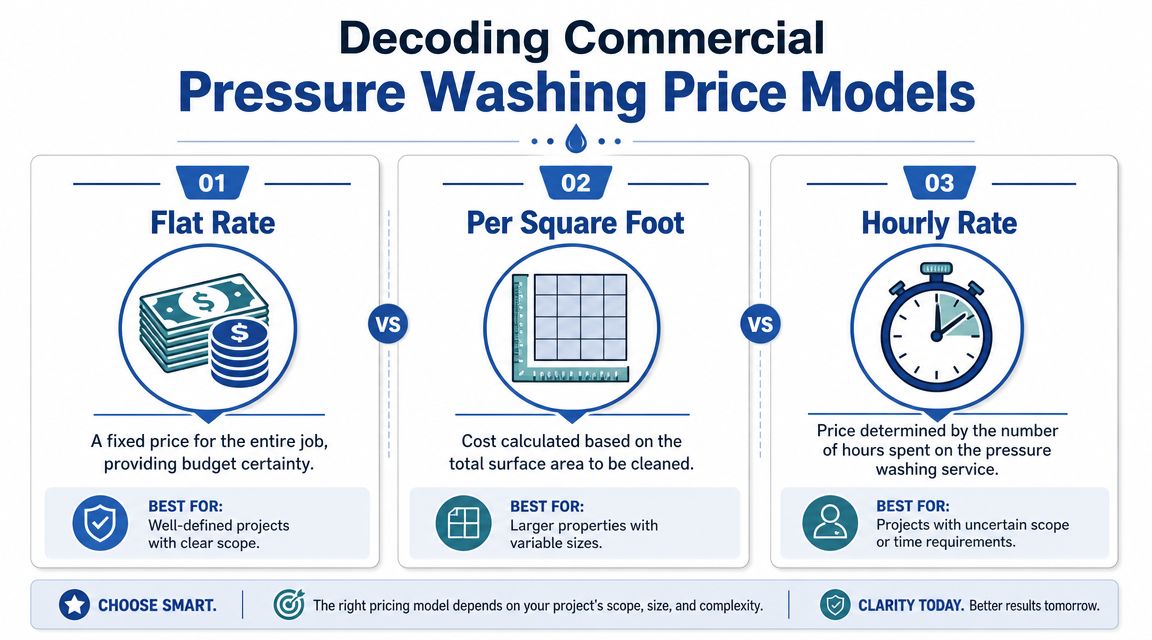
Not all estimates are built the same way. One contractor may quote by the square foot. Another may give you a flat project price. A third may bill by the hour because the cleaning conditions are unpredictable.
Per square foot pricing
This model is easiest to understand when the surfaces are measurable and fairly uniform. Sidewalks, plazas, parking stalls, breezeways, and large concrete areas often fit this structure well.
A common commercial range is $0.08 to $0.40 per square foot, based on pressure washing pricing guidance for service businesses. For buyers, the benefit is transparency. You can usually see the area, understand the math, and compare one quote to another more easily.
The catch is that not all square feet clean the same. Light soil on open concrete is one thing. Heavy grease, gum, rust, or shaded mildew is another.
Hourly pricing
Hourly pricing usually shows up when the contractor can't reasonably predict production speed without seeing how the surface responds. This happens with stain removal, detailed cleanup around obstacles, or mixed surfaces where pressure must be adjusted constantly.
From a property manager's perspective, hourly pricing works best when the scope is flexible. Maybe you want a crew on-site for a set service window and you'd rather have them prioritize what matters most. It works less well when you need a fixed budget before approval.
Flat rate pricing
Flat-rate quoting is common on smaller commercial projects and on jobs where an experienced contractor has already seen enough similar sites to know the likely labor and equipment needs. It gives you budget certainty, which is why many managers prefer it.
But flat-rate pricing only works when the scope is clearly defined. If the quote says “building wash” and doesn't identify what's included, you may end up comparing apples to oranges.
The best estimate isn't the one with the cleanest format. It's the one that clearly defines the surfaces, method, access assumptions, and exclusions.
What these models reveal about the contractor
Every serious company has to recover real operating costs before profit. That same pricing guidance notes the practical floor is set by break-even cost, including labor burden, overhead, chemicals, and equipment allocation, and recommends a 20% to 40% target margin after those costs are calculated in commercial pressure washing pricing models.
That matters for one reason. If a bid is dramatically low, somebody is usually giving up something important:
- Time on site
- Proper pretreatment
- Insurance and overhead
- The right equipment for the surface
- Post-cleanup and water control
A fair quote should let the contractor do the work correctly without rushing through the parts you care about.
Seven Key Factors That Influence Your Final Price
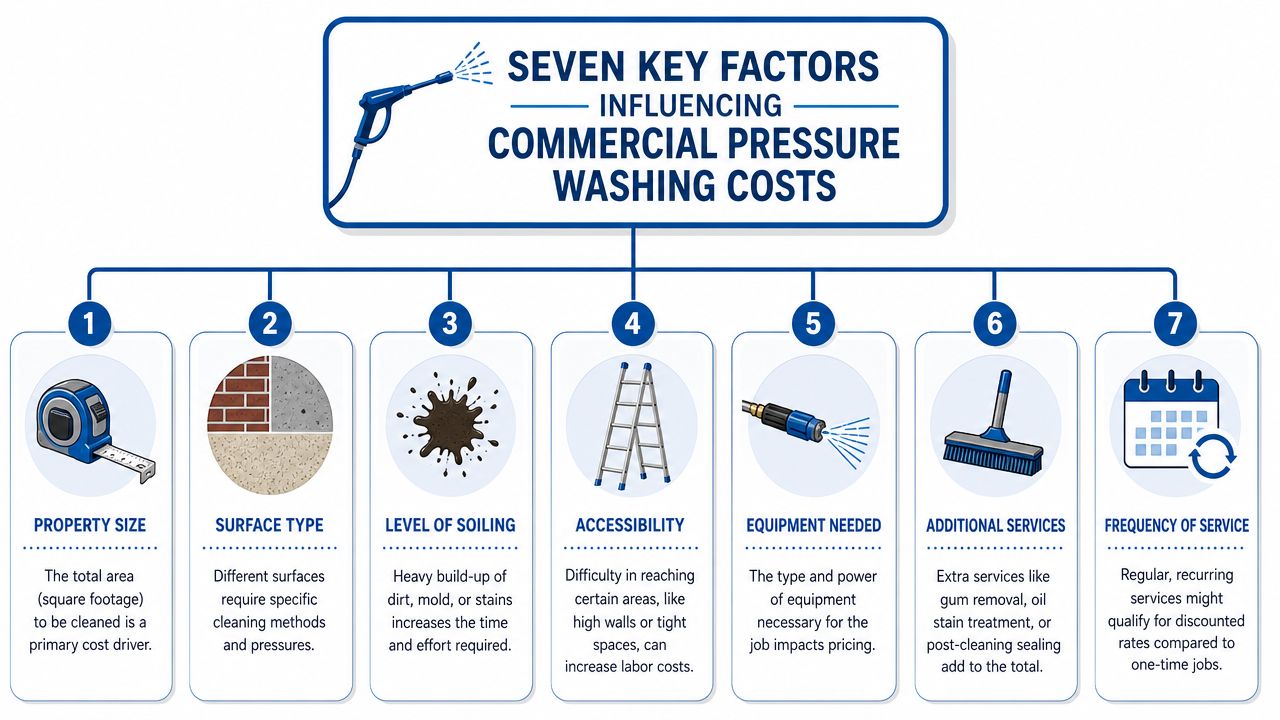
The final commercial pressure washing cost comes from job conditions, not just dimensions. Two properties with similar square footage can price very differently once you look at use, staining, access, and cleaning method.
Property size and layout
Large open concrete areas usually clean faster per square foot than broken-up spaces with curbs, planters, furniture, drive-thru lanes, bollards, or narrow walkways. A site with interruptions forces the technician to stop, switch wand angles, move hoses, and detail edges.
That's one reason independent guides show a broad spread for commercial flatwork, from about $0.08 to $0.30 per square foot in one estimate and $0.42 to $0.52 per square foot in another, as summarized in commercial pressure washing cost ranges. Layout affects production speed more than many buyers expect.
Surface type and cleaning method
Concrete can usually take a more aggressive approach than painted stucco, EIFS, aged coatings, decorative masonry, or exterior panels. If the wrong pressure is used on a delicate finish, the cleaning cost you saved can turn into a repair cost you didn't budget for.
Method matters. Some surfaces need pressure. Others need soft washing, detergent dwell time, and controlled rinsing. The cleaner who knows the difference protects the finish and the warranty.
Soil load and stain type
Dry Arizona dust is one thing. Embedded tire marks, oil, gum, food spills, rust runoff, bird droppings, and dumpster pad contamination are something else. Heavier contamination usually means more than water pressure. It may require pretreatment, agitation, hot water capability, spot work, or multiple passes.
A low bid often assumes light soil. A higher bid may reflect the chemistry and labor needed to remove what you want gone.
Field note: If a contractor doesn't ask what the stains are, they're probably pricing the job too loosely.
Height and accessibility
Ground-level flatwork is usually the easiest part of a project to price. Upper facades, loading dock walls behind obstacles, enclosed courtyards, and areas with limited drainage or public exposure take more planning.
Access issues raise cost because they affect setup, safety, hose management, technician pace, and sometimes equipment choice. In Phoenix retail centers and office complexes, this often matters more than raw square footage.
Equipment and water logistics
Commercial cleaning isn't one machine and one nozzle. The right setup might include a surface cleaner for flatwork, downstream chemical application, extension tools for vertical surfaces, containment measures, or degreasing tools for service areas.
Water access also matters. Long hose runs, poor pressure at the spigot, restricted service times, and occupied spaces can all slow the job. None of that looks dramatic on a quote, but it shows up in labor.
Extra scope beyond standard washing
Many commercial sites need more than a rinse. Common add-ons include:
- Gum removal: Slow, detailed work that can't be rushed
- Oil treatment: Often needs targeted chemistry and repeat attention
- Dumpster pad sanitation: Usually involves heavier buildup and odor control concerns
- Entry detail cleaning: Corners, curbs, and edges take time
- Post-construction cleanup: Fine dust and material residue behave differently than regular grime
For parking surfaces and traffic-heavy common areas, parking lot pressure washing in Phoenix gives a better picture of how site use changes scope.
Frequency of service
A property cleaned on a maintenance schedule is usually simpler and faster to keep presentable than a site that gets attention only when ownership complains. Regular service doesn't magically make every cleaning cheap, but it often prevents severe buildup that turns a routine wash into a restoration-style job.
Sample Pressure Washing Estimates in the Phoenix Area
National benchmarks are useful, but most managers want local context. In the Valley, the biggest pricing swings usually come from dust accumulation, sun-cured staining, restaurant grease, and the amount of detailing required around high-traffic areas.
Retail storefront in Chandler
A small retail storefront with a dusty sidewalk, entrance concrete, and front-facing exterior cleaning often lands near the lower end of the standard commercial range when access is easy and the soil is mostly dust and tracked-in grime. If the surface area is limited and the scope is straightforward, this kind of job may resemble the smaller-project benchmarks where 500 to 1,000 square feet is estimated at $110 to $440 in commercial rate examples by project size.
If gum, beverage spills, and shaded staining are present, the quote moves up because production slows. The same happens when storefront work must be done before opening or in a tight service window.
Restaurant patio in Scottsdale
Restaurant patios are rarely “just surface cleaning.” Chairs need moving. Food residue and grease need treatment. The edges near planters, walls, and drains need more hand work than open concrete.
A patio with moderate buildup may still fit within the broader market range discussed earlier, but greasy traffic lanes and spill zones usually push pricing toward the middle rather than the bottom. In Scottsdale, managers also tend to care more about uniform appearance, which means spot-cleaning only the worst areas often isn't enough.
A restaurant quote that looks cheap on paper can leave behind grease shadows, gum, and dirty edges. Those are the details guests notice first.
Two-story office building in Tempe
A two-story office facade introduces method and access issues right away. Painted stucco, block, and trim often require a gentler cleaning approach than flat concrete. If the goal is to remove dust, cobwebs, and organic staining without damaging coatings, the contractor may need a soft-wash process rather than aggressive pressure.
That usually prices differently than sidewalk cleaning because you're paying for controlled application, reach, safety planning, and finish protection. If there are narrow side yards, landscaping constraints, or parked vehicles that can't be moved, labor goes up.
Industrial concrete area in Gilbert
Industrial sites can be deceptively difficult. Open concrete may seem simple, but oil, tire transfer, equipment residue, and repeated-use staining don't release the way retail dust does. The work often involves heavier pretreatment and a more realistic conversation about what can be improved versus what's permanently embedded.
If your property budget also includes remediation after leaks or interior water events, it helps to compare service categories realistically. Resources like Phoenix AZ water restoration costs show how quickly emergency cleanup pricing differs from routine maintenance. Pressure washing is usually more cost-effective when it's scheduled before grime becomes a deeper facility problem.
Contract Pricing vs One-Time Service What to Choose
A one-time cleaning makes sense when you've just taken over a property, you're preparing for an inspection, or you need to reset appearance after construction, tenant turnover, or a long period of neglect. But for most occupied commercial sites, reactive cleaning is the more expensive habit.
The industry data supports that view. The U.S. pressure washing services industry generated $1.23 billion in revenue in 2023, and the average cost per commercial pressure washing job was $1,200 in 2023, according to pressure washing industry statistics. That tells property managers something important. This isn't a rare specialty purchase. It's a routine operating expense that benefits from planning.
When one-time service works
One-time service is the better fit when:
- You need a reset: The site hasn't been cleaned in a long time and you need a full baseline wash.
- The scope is temporary: Construction dust, event cleanup, or a single leasing push may not justify a recurring program.
- Ownership is testing vendors: Some managers prefer to evaluate workmanship before approving a regular schedule.
That approach is practical, but it often means each visit starts from a dirtier condition. The contractor spends more time correcting buildup instead of maintaining a clean surface.
Why contract service usually wins
Contract pricing gives you three advantages that matter in day-to-day property management.
First, it makes budgeting easier. You're not scrambling for approval every time an entrance starts looking bad.
Second, regular cleaning protects appearance standards. Retail walkways, office entries, dumpster areas, and customer-facing exteriors don't all decline at the same speed. A schedule lets you match service frequency to use.
Third, maintenance reduces the chance that grime becomes a bigger labor problem. Oil, organics, and embedded traffic staining are much easier to manage early than after months of neglect.
Scheduled service usually buys consistency more than it buys a dramatic discount. For most commercial properties, consistency is the real value.
A simple decision test
Choose one-time service if the property has an unusual, isolated need.
Choose contract service if the building is occupied, customer-facing, and expected to look cared for all year. That's especially true in Phoenix, where dust and high use can make a property look tired faster than ownership expects.
How to Get an Accurate Quote and Reduce Your Costs
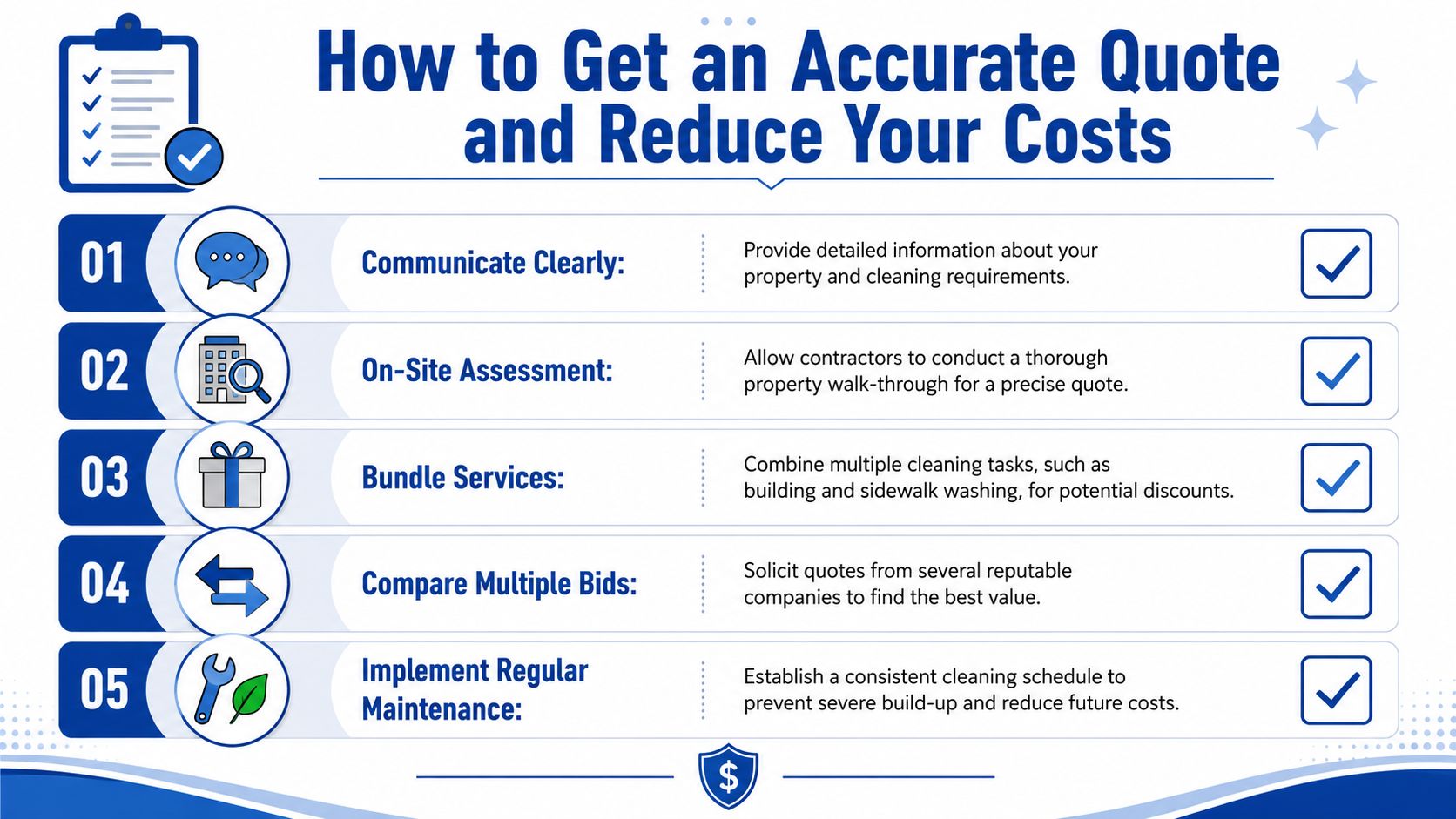
Most pricing problems start before the contractor even arrives. If the scope is vague, the estimate will be vague too. The fastest way to get a useful quote is to give clear information and make site conditions easy to evaluate.
What to send before the walkthrough
Start with photos of the exact areas you want cleaned. Don't just send the best angle of the building. Include the service lane, dumpster area, greasy corners, shaded walls, and any spots you know ownership notices.
A good request should also identify:
- Access restrictions: Gates, tenant hours, loading activity, or security requirements
- Surface types: Concrete, painted block, stucco, decorative stone, coated surfaces
- Problem stains: Oil, gum, rust, mildew, food spills, or heavy dust
- Water and drainage conditions: Where the crew can connect and where runoff needs attention
Ways to lower cost without lowering quality
You can often improve value by changing scope and timing instead of pushing for the cheapest bid.
- Bundle related services: Combining exterior cleaning tasks can reduce repeated setup and travel. One practical option is to pair facade or flatwork service with window cleaning from providers such as South Mountain Window Cleaning, LLC when that fits your maintenance schedule.
- Approve a site visit: Walkthroughs prevent underbidding and surprise change orders.
- Clean on a schedule: Lighter, regular service is usually easier to price and easier to maintain.
- Prioritize zones: If budget is tight, focus first on customer-facing areas and slip-risk or grease-prone surfaces.
What to verify before you hire
Don't treat insurance and professionalism as extras. They're part of the cost equation.
Ask whether the company is licensed, bonded, and insured. Ask what method they plan to use on each surface. Ask what is not included. A detailed answer is usually a good sign. A rushed price with no scope language usually isn't.
Get Your Free Commercial Pressure Washing Quote in Phoenix
The right commercial pressure washing cost isn't the lowest number on the page. It's the number that reflects the actual scope, uses the right method for the surface, and protects your property from avoidable damage.
For Phoenix-area managers, that usually means working with a contractor who can clean concrete, storefront approaches, building exteriors, and related surfaces without turning a maintenance item into a liability issue. It also means getting a quote that clearly identifies what's included, what method will be used, and how access or stain conditions affect the final price.
That same budgeting mindset applies across the property. If you're comparing exterior maintenance priorities, guides like Wilcox Door Service Inc. on repair budgets are a useful reminder that small facility issues are easier to manage when they're planned instead of deferred.
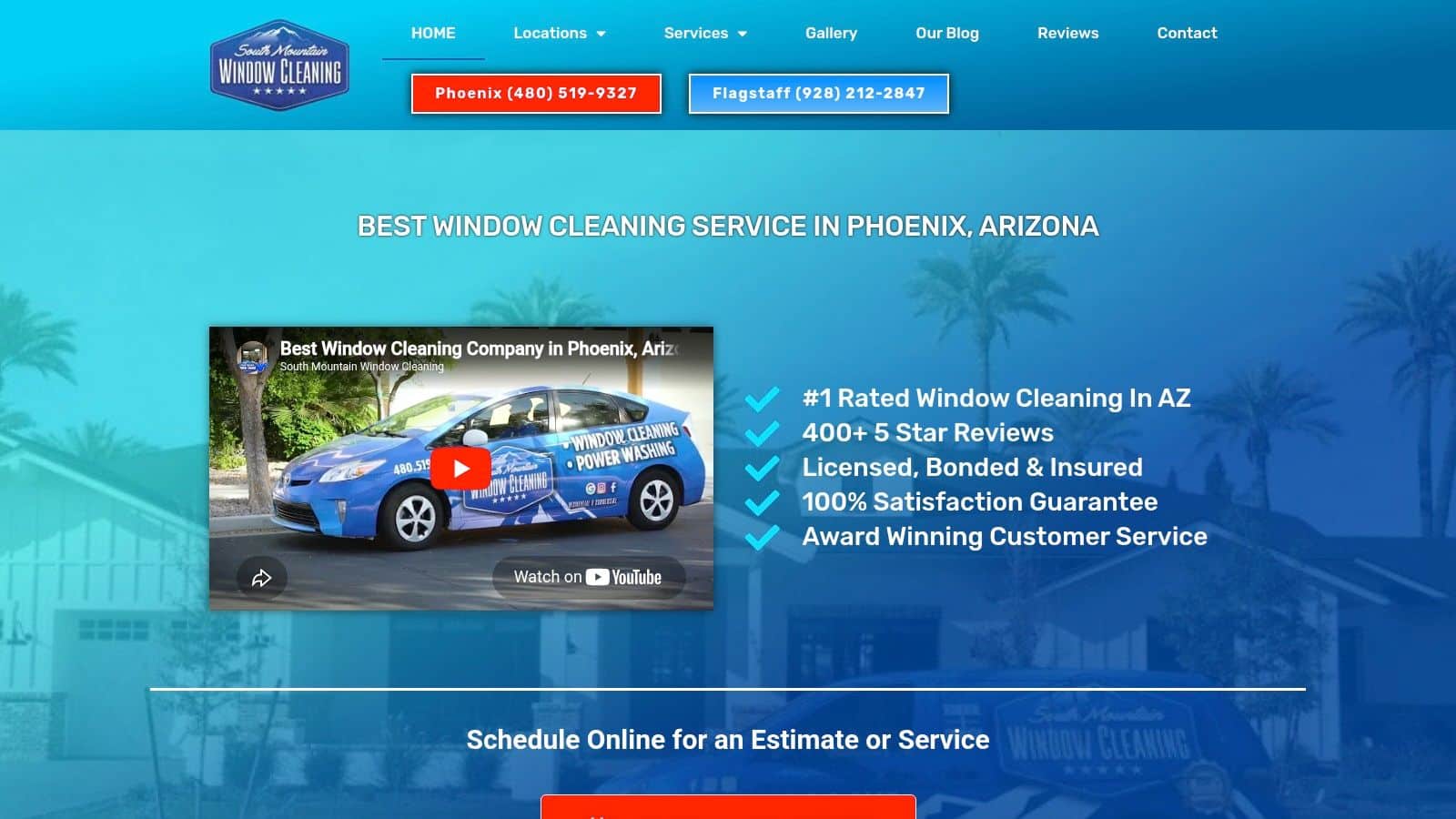
South Mountain Window Cleaning serves commercial properties across Phoenix, Scottsdale, Paradise Valley, Chandler, Tempe, and Gilbert. The company is licensed, bonded, and insured, and it carries a $2 million insurance policy as described in its published company information. For property managers, that matters because exterior cleaning should improve your site, not introduce risk.
A short look at the team and service approach helps before you request pricing:
If you want a useful quote, send the property address, photos of the areas you want cleaned, any access restrictions, and a note about problem spots like gum, grease, or shaded buildup. That gives the estimator enough detail to price the work accurately and recommend the right service frequency.
If you manage a commercial property in Phoenix and want a clear, detailed estimate for exterior cleaning, request a free quote from South Mountain Window Cleaning, LLC.