
A lot of Arizona patios look great from inside the house and sit mostly unused in real life. By late morning, the slab is hot, the furniture has a film of dust, and once the sun drops, bugs start showing up right when you finally want to sit outside.
That's why so many Valley homeowners look into a screen in patio project. In Phoenix, Scottsdale, Chandler, Gilbert, and nearby areas, the question usually isn't whether a patio needs more comfort. It's whether screening it in will help in a desert climate. In many cases, it does, but only when the design matches Arizona conditions instead of a generic porch plan copied from another region.
Is a Screened Patio Worth It in Arizona?
For Arizona homes, a screened patio usually makes sense when the problem is usability, not indoor-style cooling. The biggest gain is often simpler than people expect. You get less blowing debris, fewer insects, and more comfortable morning and evening use.
According to guidance on screened porch use in hot climates, the practical value of a screened patio is often less about temperature control and more about dust and debris reduction, insect exclusion, and making outdoor areas usable during shoulder seasons. That same guidance makes an important point: the goal is extending usable hours and reducing cleaning frequency, not turning the space into an air-conditioned room.
What Arizona homeowners actually gain
A screened patio works well here when you want to solve everyday annoyances:
- Less dust on furniture: Screens won't stop every bit of fine desert dust, especially during a haboob, but they can cut down the debris that constantly lands on tables, grills, and cushions.
- Fewer insects during dusk: If you like sitting outside after sunset, screening gives you a more controlled space without fully enclosing the patio with glass.
- More useful shoulder-season hours: Spring mornings, fall evenings, and even winter afternoons can be much more enjoyable when the patio feels protected rather than exposed.
- Cleaner transitions from yard to house: Screened areas tend to collect less blowing leaf litter and less tracked-in dirt than open patios.
In Arizona, the win isn't “making outside feel like inside.” The win is finally getting a patio you'll actually use more than a few weeks a year.
Where expectations go wrong
A screen room won't fix a west-facing patio with no shade strategy. It also won't make a concrete slab feel cool in July on its own. If the roof traps heat, the orientation is brutal, and there's no airflow, adding mesh won't magically solve those issues.
That's why smart Arizona projects pair screening with practical choices like better shade, a ceiling fan, less heat-retaining furniture placement, and storage that keeps cushions protected from weather and dust. If you're also trying to reduce patio clutter, weatherproof outdoor storage ideas from Van Dyke Outdoors are worth reviewing before you finalize the layout.
For many homeowners, a screen in patio setup is worth it because it turns a high-maintenance outdoor area into a lower-hassle one. That's a realistic standard, and in the desert, realistic standards usually lead to better projects.
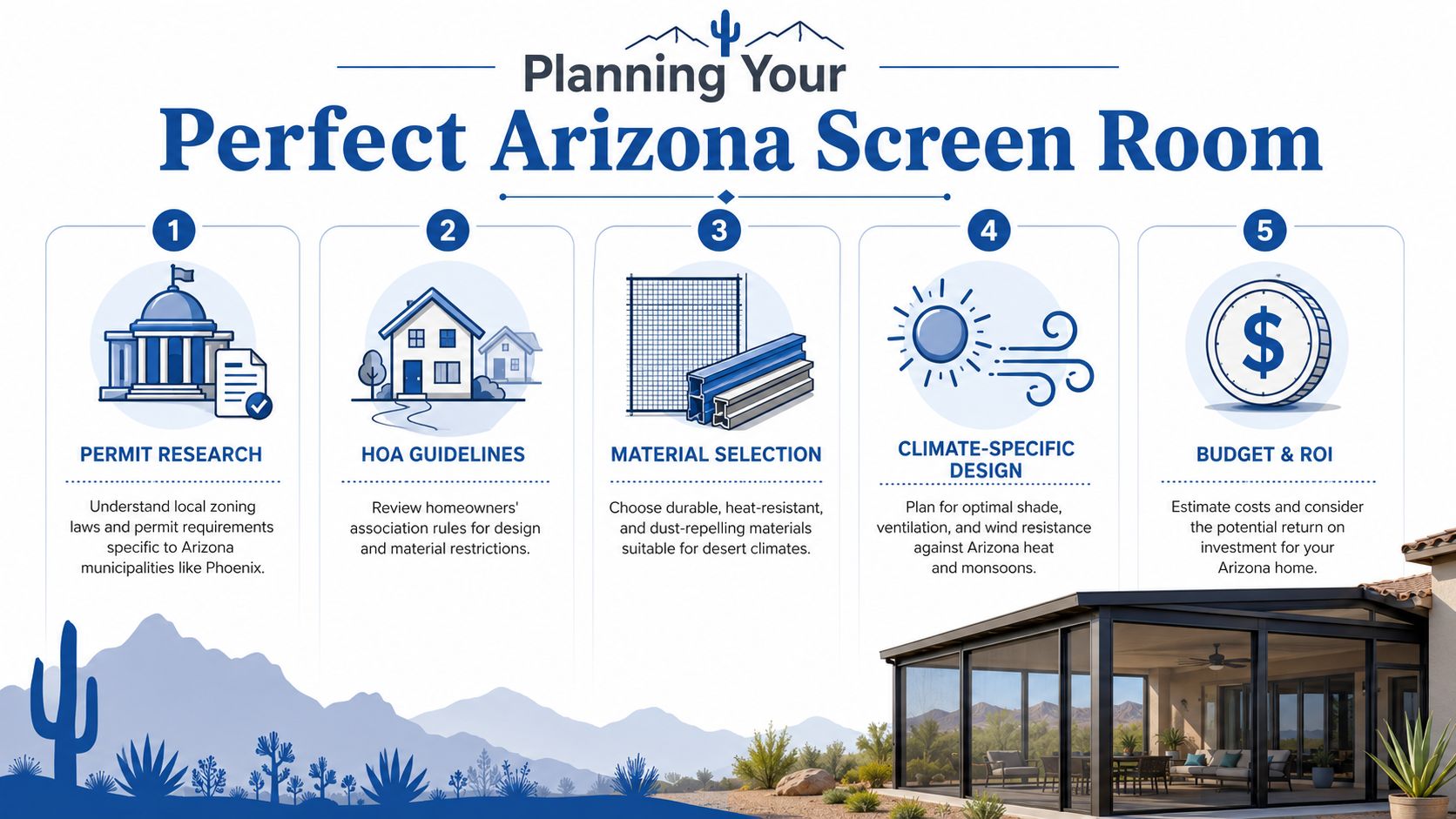
Planning Your Perfect Arizona Screen Room
The best patio screen projects are won before any frame goes up. In Arizona, planning matters because you're dealing with strong UV exposure, seasonal wind, neighborhood design rules, and the simple fact that large patio openings behave differently than small window screens.
Start with approvals before materials
In the Phoenix metro area, homeowners often focus on color and mesh first. That's backwards. Start with what your property allows.
Check these early:
HOA design rules
Many communities in Scottsdale, Chandler, Gilbert, and Ahwatukee care about frame color, roofline changes, visible posts, and whether the enclosure alters the front or rear elevation.City permit requirements
If the project changes the structure, adds framing, or modifies roofing, you may need permits. Requirements vary by municipality, so don't assume your neighbor's setup applies to your house.Existing patio condition
Look at slab cracks, fascia condition, attachment points, and whether the current cover was built to support changes.
Practical rule: If you're attaching anything permanent to an existing patio cover, verify approvals and structural condition first. Reworking a bad attachment later costs more than slowing down upfront.
Pick a mesh that fits patio-sized openings
For large patio spans, standard window-screen thinking usually causes problems. A patio opening gets more movement, more sun, and more abuse than a typical residential window.
A solid baseline comes from Metro Screenworks' patio and pool screen guidance, which identifies 18×14 mesh with a .013-inch strand diameter as a widely used benchmark for larger patio applications. The same guidance notes that charcoal-colored mesh is typically recommended for better outward visibility and UV stability.
If you want a deeper look at common material choices, this guide to the best screen for a porch is useful for comparing mesh styles before you order anything.
Arizona screen material comparison
| Material | UV Resistance | Durability | Visibility | Typical Cost |
|---|---|---|---|---|
| Standard fiberglass insect screen | Fair to good in mild exposure | Moderate | Good | Lower |
| Aluminum screen | Good | Good, but can kink or crease | Good | Moderate |
| Heavy-duty patio or pool screen | Better suited for large openings | Higher | Good | Moderate to higher |
| Pet-resistant screen | Strong against clawing and pushing | High | Slightly reduced compared with lighter mesh | Higher |
| Solar or sun-control screen | Built more for shading and privacy goals | Varies by product | Lower outward openness than standard insect screen | Higher |
This table is qualitative on purpose. In the field, the right choice depends less on a generic ranking and more on the opening size, exposure, and who uses the patio. A dog that leans on the lower panel changes the recommendation. So does a west-facing opening that takes hard afternoon sun.
Don't rely on mesh alone
Large screened walls need support. On taller sections, installers often improve rigidity with horizontal breaks instead of leaving one uninterrupted field of mesh. Metro Screenworks notes the common patio-screen benchmark above, and Screenmobile's porch guidance, summarized in the verified brief, also highlights that chair rails around 40 inches above deck height can improve structural integrity. That matters because a clean-looking wall still needs to hold tension over time.
For visual privacy ideas, it can help to look outside the patio-screen category too. This example of installing Sunbelly privacy screens in Ottawa isn't an Arizona patio build, but it's a useful reference for thinking through sightlines, shade, and how screening changes the feel of an outdoor room.
Design choices that work better in the desert
A good Arizona screen room usually includes a few practical decisions:
- Darker mesh colors: Charcoal tends to look cleaner from inside and usually gives better outward visibility than lighter colors.
- Replaceable sections: If one panel tears after a storm or pet impact, modular sections are easier to service than one oversized custom span.
- Protected furniture zones: Keep upholstered seating away from the most wind-exposed openings.
- Drainage awareness: If rain blows in from one side, don't place built-ins or delicate finishes there.
The patio should still breathe. If you overbuild it with the wrong material in the wrong place, you can end up with a room that feels boxed in, gathers grime in corners, and looks dated faster than the house around it.
Building Your Screened Patio DIY vs Pro
A screen in patio project sits right on the line between doable and easy-to-get-wrong. Replacing a small screen panel is one thing. Building a clean, durable enclosure across a large patio opening is another.
When DIY makes sense
DIY can work if your project is simple. Think existing covered patio, straightforward rectangular openings, accessible work height, and no major structural changes.
You'll usually need accurate measuring, a screen roller, spline, a utility knife, drill/driver, level, saws for framing as needed, and patience for tensioning the mesh evenly. Most first-time installers underestimate that last part. A panel can look fine at first, then show waves, sagging, or pulled corners after sun and wind start working on it.
DIY tends to fit homeowners who are comfortable with finish carpentry and careful layout work. It's less forgiving than it looks from a five-minute video clip.
When a pro is the safer route
Once the project involves roof connections, oversized openings, custom framing, or exposure to heavy wind, professional installation becomes a different conversation. This isn't only about appearance. It's about structural behavior.
According to Texas Department of Insurance guidance for screen enclosures, screen enclosures require careful engineering because porous screens affect wind loads differently than solid walls. That guidance also notes that design must account for screen drag forces and proper anchorage to the ground. In Arizona, that matters during monsoon season when wind can hit a patio from changing directions and stress weak attachments.
A screen room shouldn't be treated like a decorative add-on. The frame, fasteners, and anchorage all matter once wind gets involved.
Side-by-side decision criteria
| Factor | DIY route | Professional route |
|---|---|---|
| Basic panel replacement | Often reasonable | Usually not necessary unless access is difficult |
| Large patio spans | Harder to keep straight and tight | Better fit for custom fabrication |
| Structural attachment | Risky without experience | Better handled by trained installers |
| Permit coordination | Homeowner handles paperwork | Contractor may handle or help coordinate |
| Finish quality | Depends on skill and patience | Typically more consistent |
If you're trying to understand the parts involved before deciding, a basic screen kit overview can help you see what materials and tools come into play.
A quick visual walkthrough can also help you judge whether the work matches your skill level.
What usually goes wrong
The most common failures aren't dramatic. They're the small choices that shorten the life of the build.
- Undersized mesh for a large opening: The panel loosens and looks tired fast.
- Poor frame attachment: Movement starts at the connection points, then shows up as rattling or misalignment.
- Ignoring door swing and traffic patterns: The patio functions worse after the enclosure than before.
- Skipping reinforcement in tall panels: The wall relies too much on the screen material instead of the framing.
If your patio is simple and you enjoy detail work, DIY may be enough. If the project needs engineered judgment, permit clarity, or clean long-span results, hiring a pro usually saves frustration.
Estimating the Cost of a Screened Patio in Phoenix
Patio screen pricing in Phoenix varies a lot because the project type varies a lot. A simple enclosure on an existing covered patio is one thing. A larger custom build with new framing, difficult access, upgraded doors, and HOA-driven finish requirements is another.
The cleanest way to estimate the job is to break it into cost buckets instead of searching for one “average price” that may not fit your home.
What drives the price
Most screened patio budgets come from four main categories:
- Framing and structural materials
Aluminum framing, attachment hardware, rails, and trim pieces often make up a big share of the build. - Screen material
Standard insect mesh, heavier patio mesh, pet-resistant products, and specialty visibility or shading options all change the final number. - Labor
Labor usually rises with height, complexity, custom fitting, and the amount of finish work needed to make the enclosure look integrated with the house. - Permit and compliance costs
Some homes need little more than straightforward review. Others trigger more documentation because of structural changes or HOA requirements.
A practical budgeting method
For Phoenix-area homeowners, the better approach is to gather line-item quotes based on your actual patio. Ask each contractor to separate material, labor, and any permit-related charges. That makes it much easier to compare bids fairly.
A useful budgeting checklist includes:
- Existing roof or no roof
Screening an already covered patio is a different project than creating a fully framed enclosure from scratch. - Opening sizes and shape
Long spans, odd corners, and tall sections increase fabrication and installation difficulty. - Door choice
A simple screen door and a heavier custom access door won't price the same. - Finish expectations
Color-matched trim, cleaner sightlines, and concealed details usually take more labor.
Think beyond installation cost
Value matters too, especially if you're improving a patio you plan to keep clean and use regularly. Industry estimates cited by Lifetime Enclosures put the return on investment for a screened porch at roughly 70% to 85%, and that same source notes a 2019 National Association of Realtors survey ranked screened porches as the third most valuable outdoor structure for homes.
That doesn't mean every enclosure pays back equally. It means buyers have long seen screened outdoor space as a meaningful upgrade. In Phoenix, where outdoor living matters but exposure is harsh, that added utility can be easier to appreciate than a purely decorative patio feature.
Maintaining Your Screen Enclosure in the Desert
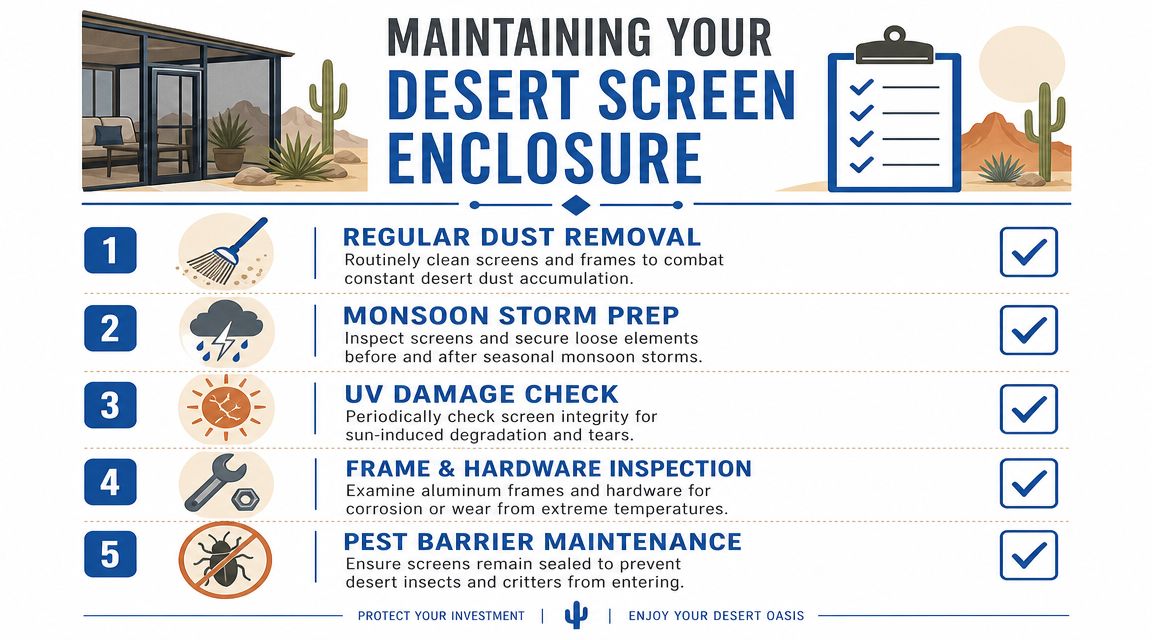
Arizona doesn't let patio screens stay clean for long. Fine dust settles in the mesh, tracks fill with grit, sun works on exposed materials every day, and monsoon winds find any weak spot you ignored in spring.
A good maintenance routine isn't complicated, but it needs to be consistent.
Your regular cleaning routine
Most homeowners do better with light, repeated cleaning than with one aggressive wash after months of buildup.
Use a soft brush, microfiber cloths, a bucket with mild soap, and a gentle hose setting if the patio allows it. Avoid blasting the mesh. High pressure can stretch screen material, force dirt deeper into corners, and loosen older spline.
A basic routine looks like this:
- Brush first: Knock loose dust off the screen and frame before adding water.
- Wash lightly: Use mild soapy water on the mesh, frame, and lower rails.
- Rinse gently: A shower-type spray works better than a hard stream.
- Dry problem areas: Wipe tracks, corners, and frame bottoms so residue doesn't turn into muddy buildup.
If you want a product-specific approach for routine upkeep, this guide to using a screen cleaner can help you choose a method that won't punish the mesh.
Clean the tracks as seriously as the screens. A patio door usually starts feeling “old” because the track is packed with grit, not because the door itself failed.
Seasonal checks that matter in Arizona
Desert maintenance is partly about timing. The patio may look fine one week and need attention fast after a dusty wind event.
Before monsoon season
Walk the enclosure slowly and inspect the lower edges, corners, door closers, and any panel that gets direct wind. Look for tiny tears, pulled spline, loose screws, and frame movement. Small issues usually show up there first.
After a haboob or storm
Don't rush straight to scrubbing. Remove loose debris first, then inspect for impact damage from branches or blown objects. If dust is thick, dry removal before wet cleaning keeps you from creating a gritty slurry across the frame and track.
During peak summer
Check sun-exposed panels for brittleness, fading, or loss of tension. West-facing sections usually age fastest because they take stronger afternoon exposure.
What not to do
A lot of screen damage comes from over-cleaning, not neglect.
Avoid these mistakes:
- Pressure washing the mesh
- Using harsh degreasers on screen fabric
- Scraping tracks with metal tools
- Letting mud sit in the lower frame channels
- Ignoring one small tear until it spreads
For homeowners who already stay on top of windows and patio care, this is usually enough to keep the enclosure looking good. The challenge starts when debris gets impacted in the track system, when access is awkward, or when damage and grime build together.
When to Call for Professional Screen and Track Care
Some patio maintenance jobs are routine. Others turn into a half-day project with poor results and a sore back.
The line is usually clear. If the issue affects function, access, or embedded grime, professional service makes more sense.
Signs the job is beyond simple DIY
Call for help when you're dealing with any of these:
- Tracks packed with impacted dirt
If the sliding door drags, chatters, or won't move cleanly after basic wiping, the debris is usually deeper than a surface clean can handle. - Hard water spotting or stubborn residue
Mineral deposits, bird droppings, and baked-on grime often need better technique than a hose and brush. - Second-story or hard-to-reach screens
Ladder work around patio enclosures gets risky fast, especially near decorative surfaces and windows. - Torn screens plus dirty framing
Once the panel needs repair and the surrounding frame needs detailed cleaning, it often makes sense to handle both with professional equipment and process.
Why detailed track cleaning matters
Homeowners often focus on the visible mesh and ignore the lower system. That's usually where function breaks down first. Sand, dust, pet hair, and organic debris settle into corners and compact over time. Then the rollers and track start doing extra work.
If you want to see what proper track cleaning involves before deciding whether to tackle it yourself, this guide on how to clean window tracks gives a clear picture of the process.
For Arizona homeowners who want help with maintenance rather than construction, South Mountain Window Cleaning, LLC is one local option that provides screen cleaning and related exterior care. That kind of service fits well when the enclosure is structurally sound but no longer looks clean, slides smoothly, or feels pleasant to use.
A screened patio should reduce hassle, not create another neglected zone around the house. When the mesh is dusty, the tracks are packed, and the whole enclosure starts looking tired, professional cleaning can bring the space back without turning it into a renovation.
If your patio screens, tracks, and surrounding windows need a reset, South Mountain Window Cleaning, LLC can help you maintain that outdoor space without the heavy DIY cleanup. For homeowners across Phoenix, Scottsdale, Paradise Valley, Chandler, Tempe, and Gilbert, professional screen and track care is a practical way to keep a screened patio cleaner, working better, and ready to use in Arizona's dusty climate.